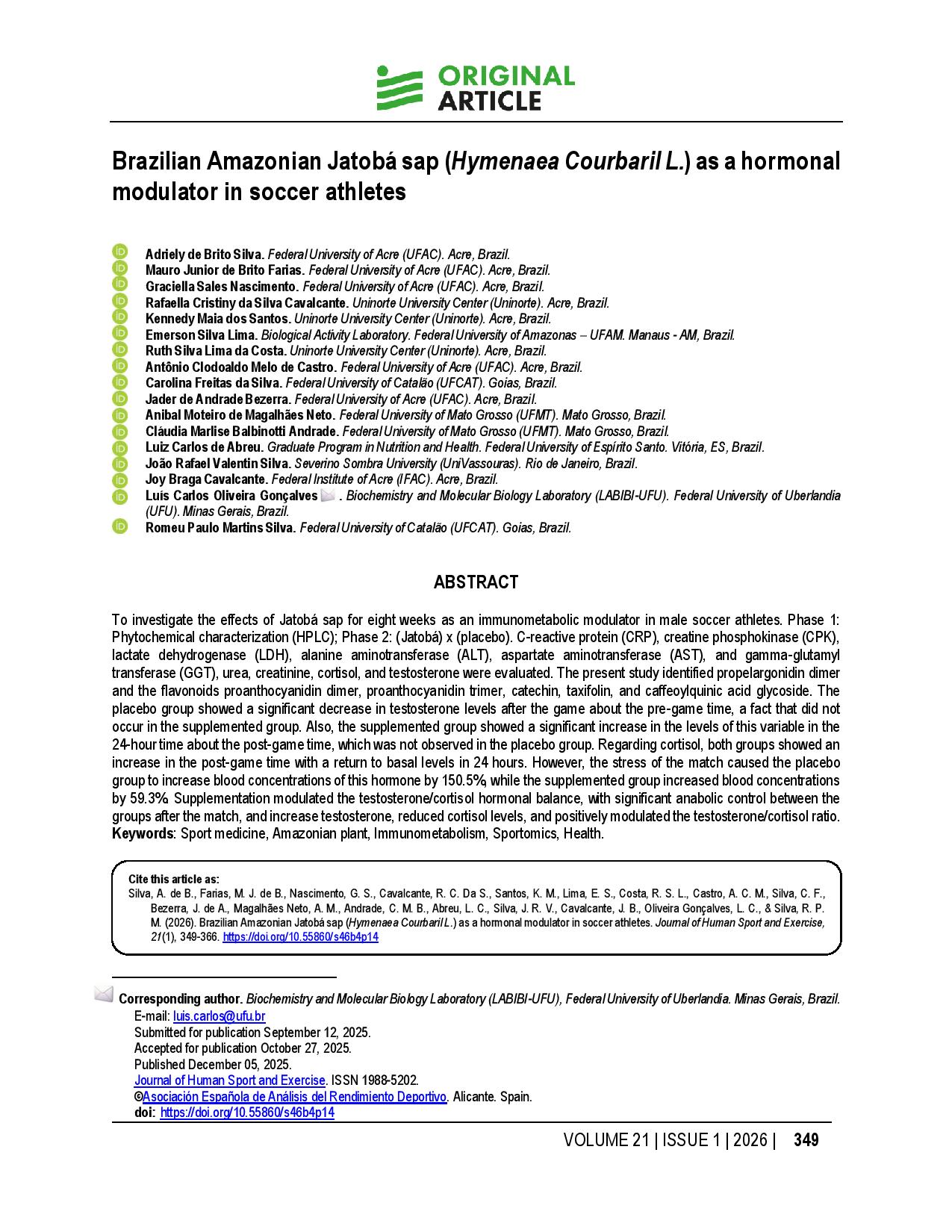
Brazilian Amazonian Jatobá sap (Hymenaea Courbaril L.) as a hormonal modulator in soccer athletes
Article Sidebar
Main Article Content
Abstract
To investigate the effects of Jatobá sap for eight weeks as an immunometabolic modulator in male soccer athletes. Phase 1: Phytochemical characterization (HPLC); Phase 2: (Jatobá) x (placebo). C-reactive protein (CRP), creatine phosphokinase (CPK), lactate dehydrogenase (LDH), alanine aminotransferase (ALT), aspartate aminotransferase (AST), and gamma-glutamyl transferase (GGT), urea, creatinine, cortisol, and testosterone were evaluated. The present study identified propelargonidin dimer and the flavonoids proanthocyanidin dimer, proanthocyanidin trimer, catechin, taxifolin, and caffeoylquinic acid glycoside. The placebo group showed a significant decrease in testosterone levels after the game about the pre-game time, a fact that did not occur in the supplemented group. Also, the supplemented group showed a significant increase in the levels of this variable in the 24-hour time about the post-game time, which was not observed in the placebo group. Regarding cortisol, both groups showed an increase in the post-game time with a return to basal levels in 24 hours. However, the stress of the match caused the placebo group to increase blood concentrations of this hormone by 150.5%, while the supplemented group increased blood concentrations by 59.3%. Supplementation modulated the testosterone/cortisol hormonal balance, with significant anabolic control between the groups after the match, and increase testosterone, reduced cortisol levels, and positively modulated the testosterone/cortisol ratio.
Downloads
Article Details
Section

This work is licensed under a Creative Commons Attribution-NonCommercial-ShareAlike 4.0 International License.
Each author warrants that his or her submission to the Work is original and that he or she has full power to enter into this agreement. Neither this Work nor a similar work has been published elsewhere in any language nor shall be submitted for publication elsewhere while under consideration by Journal of Human Sport and Exercise (JHSE). Each author also accepts that the JHSE will not be held legally responsible for any claims of compensation.
Authors wishing to include figures or text passages that have already been published elsewhere are required to obtain permission from the copyright holder(s) and to include evidence that such permission has been granted when submitting their papers. Any material received without such evidence will be assumed to originate from the authors.
Please include at the end of the acknowledgements a declaration that the experiments comply with the current laws of the country in which they were performed. The editors reserve the right to reject manuscripts that do not comply with the abovementioned requirements. The author(s) will be held responsible for false statements or failure to fulfill the above-mentioned requirements.
This title is licensed under a Attribution-NonCommercial-ShareAlike 4.0 International (CC BY-NC-SA 4.0).
You are free to:
Share — copy and redistribute the material in any medium or format.
Adapt — remix, transform, and build upon the material.
The licensor cannot revoke these freedoms as long as you follow the license terms.
Under the following terms:
-
Attribution — You must give appropriate credit, provide a link to the license, and indicate if changes were made. You may do so in any reasonable manner, but not in any way that suggests the licensor endorses you or your use.
-
NonCommercial — You may not use the material for commercial purposes.
-
ShareAlike — If you remix, transform, or build upon the material, you must distribute your contributions under the same license as the original.
- No additional restrictions — You may not apply legal terms or technological measures that legally restrict others from doing anything the license permits.
Notices:
- You do not have to comply with the license for elements of the material in the public domain or where your use is permitted by an applicable exception or limitation.
- No warranties are given. The license may not give you all of the permissions necessary for your intended use. For example, other rights such as publicity, privacy, or moral rights may limit how you use the material.
How to Cite



References
Abad, C. C. C., Barros, M. P. D., Berton, D. C., Melo, C. M. D., & Neder, J. A. (2010). Efeito do exercício aeróbico e resistido no controle autonômico e nas variáveis hemodinâmicas de jovens saudáveis. Revista Brasileira de Educação Física e Esporte, 24(4), 535-544. https://doi.org/10.1590/S1807-55092010000400010
Aldelkovic, H., Spasic, M., & Jovanovic, M. (2015). Hematological and Biochemical Parameters Elite Soccer Players During a Competitive Half Season. Journal of Medical Biochemistry, 34(4), 460-466. https://doi.org/10.2478/jomb-2014-0057
Aljaloud, S. O., & Ibrahim, S. A. (2013). Use of Dietary Supplements among Professional Athletes in Saudi Arabia. Journal of Nutrition and Metabolism, 2013, 1-7. https://doi.org/10.1155/2013/245349
Andrzejewski, M., Chmura, P., & Chmura, J. (2021). Anabolic-catabolic hormonal responses in youth soccer players during a half-season. Research in Sports Medicine, 29(2), 141-154. https://doi.org/10.1080/15438627.2020.1734930
Araújo, A. C. M., & Soares, Y. N. G. (1999). Pattern of Utilization of Protein Supplements in Academies in Belém, Pará. Revista de Nutrição, 12(1), 5-19. https://doi.org/10.1590/S1415-52731999000100007
Araújo, D. S. M. S., & Araújo, C. G. S. (2000). Aptidão física, saúde e qualidade de vida relacionada à saúde em adultos. Revista Brasileira de Medicina do Esporte, 6(5), 194-203. https://doi.org/10.1590/S1517-86922000000500005
Barbalho, S. M., Bueno, P. C. D. S., & Chagas, E. F. B. (2015). Metabolic syndrome, atherosclerosis and inflammation: An inseparable triad? Jornal Vascular Brasileiro, 14(4), 319-327. https://doi.org/10.1590/1677-5449.04315
Benedict, M., & Zhang, X. (2017). Non-alcoholic fatty liver disease: An expanded review. World Journal of Hepatology, 9(16), 715-732. https://doi.org/10.4254/wjh.v9.i16.715
Boniface, P. K., Ferreira, S. B., & Kaiser, C. R. (2017). Current state of knowledge on the traditional uses, phytochemistry, and pharmacology of the genus Hymenaea. Journal of Ethnopharmacology, 206, 193-223. https://doi.org/10.1016/j.jep.2017.05.024
Bowtell, J., & Kelly, V. (2019). Fruit-Derived Polyphenol Supplementation for Athlete Recovery and Performance. Sports Medicine, 49(1), 3-23. https://doi.org/10.1007/s40279-018-0998-x
Caramori, S. S., Lima, C. S., & Fernandes, K. F. (2004). Biochemical characterization of selected plant species from Brazilian Savannas. Brazilian Archives of Biology and Technology, 47(2), 253-259. https://doi.org/10.1590/S1516-89132004000200013
Cavalcante, J. B., Silva, A. S., & Santos, M. S. (2022). Courbaril extract (hymenaea courbaril l.) improve the explosive strength more than monohydrate creatine and decreases the muscle damage. Journal of Physical Education and Sport, 22(5), 1234-1245. https://doi.org/10.7752/jpes.2022.05155
Chia, J. S., Lee, C. L., & Chen, C. M. (2017). Effects of Caffeine Supplementation on Performance in Ball Games. Sports Medicine, 47(12), 2453-2471. https://doi.org/10.1007/s40279-017-0763-6
Collins, J., Maughan, R. J., & Gleeson, M. (2021). UEFA expert group statement on nutrition in elite football. Current evidence to inform practical recommendations and guide future research. British Journal of Sports Medicine, 55(4), 416-442. https://doi.org/10.1136/bjsports-2019-101961
Coppalle, S., Rannou, F., & Le Mat, Y. (2019). Relationship of Pre-Season Training Load With Peformance in Professional Soccer Players. Frontiers in Physiology, 10, 1-32. https://doi.org/10.3389/fphys.2019.00409
Costa, R. S. L., Brito, M. V. H., & Santos, C. H. B. (2021a). Antioxidant effect of Hymenaea courbaril L (Jatob) sap on the healing of wounds on mice. Journal of Medicinal Plants Research, 15(4), 160-171. https://doi.org/10.5897/JMPR2021.7091
Costa, R. S. L., Brito, M. V. H., & Santos, C. H. B. (2021b). Determination of Antioxidant Activity by the D.P.P.H. and Dosage of Phenols and Flavonoids in Extracts of the Bark and Sap of Hymenaea courbaril L (Jatobá). European Academic Research, 9(4), 2505-2516.
Dornas, W. C., Oliveira, T. T., & Takahashi, J. A. (2007). Flavonóides: Potencial Terapêutico no Estresse Oxidativo. Revista de Ciências Farmacêuticas Básica e Aplicada, 28(3), 241-249.
Duarte, M. M., Gomes, J. P., & Santos, M. C. L. (2016). Caracterização morfológica do fruto, semente e plântula e germinação de Hymenaea courbaril L. (Fabaceae) ("Jatobá"). Journal of Seed Science, 38(3), 204-211. https://doi.org/10.1590/2317-1545v38n3159734
Eloff, J. N. (1998). Which extractant should be used for the screening and isolation of antimicrobial components from plants? Journal of Ethnopharmacology, 60(1), 1-8. https://doi.org/10.1016/S0378-8741(97)00123-2
Fransson, D., Nielsen, J. J., & Krustrup, P. (2018). Skeletal muscle and performance adaptations to high-intensity training in elite male soccer players: speed endurance runs versus small-sided game training. European Journal of Applied Physiology, 118(1), 111-121. https://doi.org/10.1007/s00421-017-3751-5
Giannini, E. G., Testa, R., & Savarino, V. (2005). Liver enzyme alteration: a guide for clinicians. CMAJ, 172(3), 367-379. https://doi.org/10.1503/cmaj.1040752
Goyke, N., & Orr, B. (2018). The Local Migration of Plant-Based Medicines from Rural Communities to Gral. E. Aquino, Paraguay. Natural Resources, 9(12), 429-447. https://doi.org/10.4236/nr.2018.912027
Gunalan, E., Yilmaz, A. K., & Gelen, E. (2022). Dietary Supplement Use of Turkish Footballers: Differences by Sex and Competition Level. Nutrients, 14(18), 3863. https://doi.org/10.3390/nu14183863
Hackney, A. C. (2020). Hypogonadism in Exercising Males: Dysfunction or Adaptive-Regulatory Adjustment? Frontiers in Endocrinology, 11, 1-16. https://doi.org/10.3389/fendo.2020.00011
Haskell, W. L., Lee, I. M., & Pate, R. R. (2007). Physical activity and public health: Updated recommendation for adults from the American College of Sports Medicine and the American Heart Association. Medicine and Science in Sports and Exercise, 39(8), 1423-34. https://doi.org/10.1249/mss.0b013e3180616b27
Haycraft, J. A. Z., Rogers, D. K., & Robertson, S. (2017). Physical characteristics of players within the Australian Football League participation pathways: a systematic review. Sports Medicine - Open, 3(1), 46. https://doi.org/10.1186/s40798-017-0109-9
Heisterberg, M. F., Fahrenkrug, J., & Krustrup, P. (2013). Extensive Monitoring Through Multiple Blood Samples in Professional Soccer Players. Journal of Strength and Conditioning Research, 27(5), 1260-1271. https://doi.org/10.1519/JSC.0b013e3182653d17
IPAM/USAID (Instituto de Pesquisa Ambiental da Amazônia/ Agência dos Estados Unidos para o Desenvolvimento Internacional). (2011). Guia de boas práticas para a extração da seiva de jatobá (Hymenaea courbaril L.). Rio Branco, Acre, Brazil.
Julian, R., Page, R. M., & Harper, D. L. (2021). The Effect of Fixture Congestion on Performance During Professional Male Soccer Match-Play: A Systematic Critical Review with Meta-Analysis. Sports Medicine, 51(2), 255-273. https://doi.org/10.1007/s40279-020-01359-9
Kinahan, A., Budgett, R., & Mazzoni, I. (2017). Structure and Development of the List of Prohibited Substances and Methods. Medicine and Sport Science, 62, 39-54. https://doi.org/10.1159/000460699
Maltai, D. C., Stopa, S. R., & Andrade, S. S. C. D. A. (2019). Evaluation of renal function in the Brazilian adult population, according to laboratory criteria from the National Health Survey. Revista Brasileira de Epidemiologia, 22(2), 1-13. https://doi.org/10.1590/1980-549720190010.supl.2
Matsudo, S. M., Matsudo, V. K. R., & Barros Neto, T. L. (2001). Atividade física e envelhecimento: aspectos epidemiológicos. Revista Brasileira de Medicina do Esporte, 7(1). https://doi.org/10.1590/S1517-86922001000100002
Maughan, R. J., Burke, L. M., & Dvorak, J. (2018). IOC consensus statement: dietary supplements and the high-performance athlete. British Journal of Sports Medicine, 52(7), 439-455. https://doi.org/10.1136/bjsports-2018-099027
Maury, G. L., Martínez, Y., & Pérez, A. (2020). Antioxidants in Plants: A Valorization Potential Emphasizing the Need for the Conservation of Plant Biodiversity in Cuba. Antioxidants, 9(11), 1-36. https://doi.org/10.3390/antiox9111048
Michaidilis, Y. (2014). Stress hormonal analysis in elite soccer players during a season. Journal of Sport and Health Science, 3(4), 279-283. https://doi.org/10.1016/j.jshs.2014.03.016
Moreno-Pérez, D., Bressa, C., & Bailén, M. (2018). Effect of a protein supplement on the gut microbiota of endurance athletes: A randomized, controlled, double-blind pilot study. Nutrients, 10(3), 337. https://doi.org/10.3390/nu10030337
Mucha, P., Skoczyńska, A., & Małecka, M. (2021). Overview of the Antioxidant and Anti-Inflammatory Activities of Selected Plant Compounds and Their Metal Ions Complexes. Molecules, 26(16), 4886. https://doi.org/10.3390/molecules26164886
Ndlec, M., Dawson, B., & Dupont, G. (2012). Recovery in Soccer: Part I-post-match fatigue and time course of recovery. Sports Medicine, 42(12), 997-1015. https://doi.org/10.2165/11635270-000000000-00000
Nieman, D. C., & Wentz, L. M. (2019). The compelling link between physical activity and the body's defense system. Journal of Sport and Health Science, 8(3), 201-217. https://doi.org/10.1016/j.jshs.2018.09.009
Oliveira, C. B., Sousa, M., & Ferreira, R. (2022). Dietary supplements usage by elite female football players: an exploration of current practices. Journal of Medical Science in Sport, 32(1), 73-80. https://doi.org/10.1111/sms.14001
Oliveira, C. C., Ferreira, D., & Caetano, C. (2017). Nutrition and Supplementation in Soccer. Sports, 5(2), 28. https://doi.org/10.3390/sports5020028
Pedrinelli, A., Pedrinelli, V., & da Mota, V. F. (2015). Medications and Nutritional Supplements in Athletes during the 2000, 2004, 2008, and 2012 FIFA Futsal World Cups. BioMed Research International, 2015, 870308. https://doi.org/10.1155/2015/870308
Pellegrini, A. R., Corrêa, F. S. N., & Barbosa, M. R. (2017). Consumo de Suplementos Nutricionais por Praticantes de Musculação da Cidade de São Carlos - SP. Revista Brasileira de Nutrição Esportiva, 11(61), 59-73.
Petry, É. R., da Silva, E. L., & da Silva, F. R. P. (2013). Suplementações Nutricionais e Estresse Oxidativo: Implicações na Atividade Física e no Esporte. Revista Brasileira de Ciências do Esporte, 35(4). https://doi.org/10.1590/S0101-32892013000400017
Pimenta, E., Coelho, D. B., & Cruz, I. R. (2016). Analysis of creatine kinase and alpha-actin concentrations in soccer pre-season. Revista Brasileira de Ciência e Movimento, 23(4), 5-14. https://doi.org/10.18511/0103-1716/rbcm.v23n4p5-14
Pinto, A. A. D. C., & Maduro, C. B. (2003). Produtos e subprodutos da medicina popular comercializados na cidade de Boa Vista, Roraima. Acta Amazonica, 33(2), 281-289. https://doi.org/10.1590/1809-4392200332290
Porrini, M., & Bo, C. D. (2016). Ergogenic Aids and Supplements. Sports Endocrinology, 47, 128-152. https://doi.org/10.1159/000445176
Putzke, J., Scherer, M., & Alovisi, A. M. T. (2016). Biodiversidade Vegetal No Parque Ambiental Da Souza Cruz Em Santa Cruz Do Sul-Rs, Brasil. Caderno de Pesquisa, 28(2), 52-141.
Raquena, B., Arjones, V., & Suarez-Arrones, L. (2017). Off-Season Effects on Functional Performance, Body Composition, and Blood Parameters in Top-Level Professional Soccer Players. Journal of Strength and Conditioning Research, 31(4), 939-946. https://doi.org/10.1519/JSC.0000000000001568
Ribeiro, D. A., Macêdo, D. G., & Oliveira, L. G. S. (2014). Therapeutic potential and use of medicinal plants in an area of the Caatinga in the state of Ceará, northeastern Brazil. Revista Brasileira de Plantas Medicinais, 16(4), 912-930. https://doi.org/10.1590/1983-084X/13_059
Rocha, L., & Pereira, M. V. L. (1998). Use of Nutritional Supplements by Subjects Enrolled in Physical Fitness. Revista de Nutrição, 11(1). https://doi.org/10.1590/S1415-52731998000100007
Saidi, K., Driss, T., & Chamari, K. (2020). The Interplay Between Plasma Hormonal Concentrations, Physical Fitness, Workload and Mood State Changes to Periods of Congested Match Play in Professional Soccer Players. Frontiers in Physiology, 11, 835. https://doi.org/10.3389/fphys.2020.00835
Santos, P. B., da Silva, J. F., & Garcia, E. S. (2012). Fatores geradores de estresse para atletas da categoria de base do futebol de campo. Motriz, 18(2), 208-217. https://doi.org/10.1590/S1980-65742012000200001
Semen, K. O., Soare, A., & Munteanu, C. (2020). Effects of Monomeric and Oligomeric Flavanols on Kidney Function, Inflammation and Oxidative Stress in Runners: A Randomized Double-Blind Pilot Study. Nutrients, 12(6), 1634. https://doi.org/10.3390/nu12061634
Senefeld, J. W., Smith, J. R., & Lunn, W. R. (2020). Ergogenic Effect of Nitrate Supplementation: A Systematic Review and Meta-analysis. Medicine & Science in Sports & Exercise, 52(10), 2250-2261. https://doi.org/10.1249/MSS.0000000000002363
Silva, L. E., Reis, R. A., & Moura, E. A. (2015). Plantas do Gênero Xylopia: Composição Química e Potencial Farmacológico. Revista Brasileira de Plantas Medicinais, 17(4), 814-826. https://doi.org/10.1590/1983-084X/14_076
Silva, J. R., Rebelo, A., & Marques, F. (2014). Biochemical impact of soccer: an analysis of hormonal, muscle damage, and redox markers during the season. Applied Physiology, Nutrition, and Metabolism, 39(4), 432-438. https://doi.org/10.1139/apnm-2013-0180
Silva, A. S. R. D., Santhiago, V., & Papoti, M. (2011). Serum and plasma hormonal concentrations are sensitive to periods of intensity and volume of soccer training. Science et Sports, 26(5), 278-285. https://doi.org/10.1016/j.scispo.2010.12.006
Slimani, M., & Nikolaidis, P. T. (2019). Anthropometric and Physiological Characteristics of Male Soccer Players According to their Competitive Level, Playing Position and Age Group: A Systematic Review. The Journal of Sports Medicine and Physical Fitness, 59(1), 141-163. https://doi.org/10.23736/S0022-4707.17.07950-6
Somerville, V., Bringans, C., & Braakhuis, A. (2017). Polyphenols and Performance: A Systematic Review and Meta-Analysis. Sports Medicine, 47(8), 1589-1599. https://doi.org/10.1007/s40279-017-0675-5
Sporis, G., Jukic, I., & Milanovic, L. (2009). Fitness profiling in soccer: physical and physiologic characteristics of elite players. Journal of Strength and Conditioning Research, 23(7), 1947-1953. https://doi.org/10.1519/JSC.0b013e3181b3e141
Taherkhani, S., Suzuki, K., & Castell, L. (2021). An Overview of Physical Exercise and Antioxidant Supplementation Influences on Skeletal Muscle Oxidative Stress. Antioxidants, 10(10), 1528. https://doi.org/10.3390/antiox10101528
Tiago, P. V., Tiago, G. V., & de Souza, A. L. (2020). Caracterização morfoanatômica, fitoquímica e histoquímica de Hymenaea courbaril (Leguminosae), ocorrente na Amazônia Meridional. Rodriguésia, 71, 1-11. https://doi.org/10.1590/2175-7860202071063
Urhausen, A., Gabriel, H., & Kindermann, W. (1995). Blood Hormones as Markers of Training Stress and Overtraining. Sports Medicine, 20(4), 251-276. https://doi.org/10.2165/00007256-199520040-00004
Vicente-Tiago, P., da Silva, J. S., & de Souza, A. L. (2019). Levantamento etnobotânico do jatobá (Hymenaea courbaril L., Fabaceae) no norte do estado de Mato Grosso, Brasil. Gaia Scientia, 13(1), 80-90. https://doi.org/10.22478/ufpb.1981-1268.2019v13n1.44089
Xu, X. Y., Meng, X., & Li, S. (2018). Bioactivity, Health Benefits, and Related Molecular Mechanisms of Curcumin: Current Progress, Challenges, and Perspectives. Nutrients, 10(10), 1-33. https://doi.org/10.3390/nu10101553