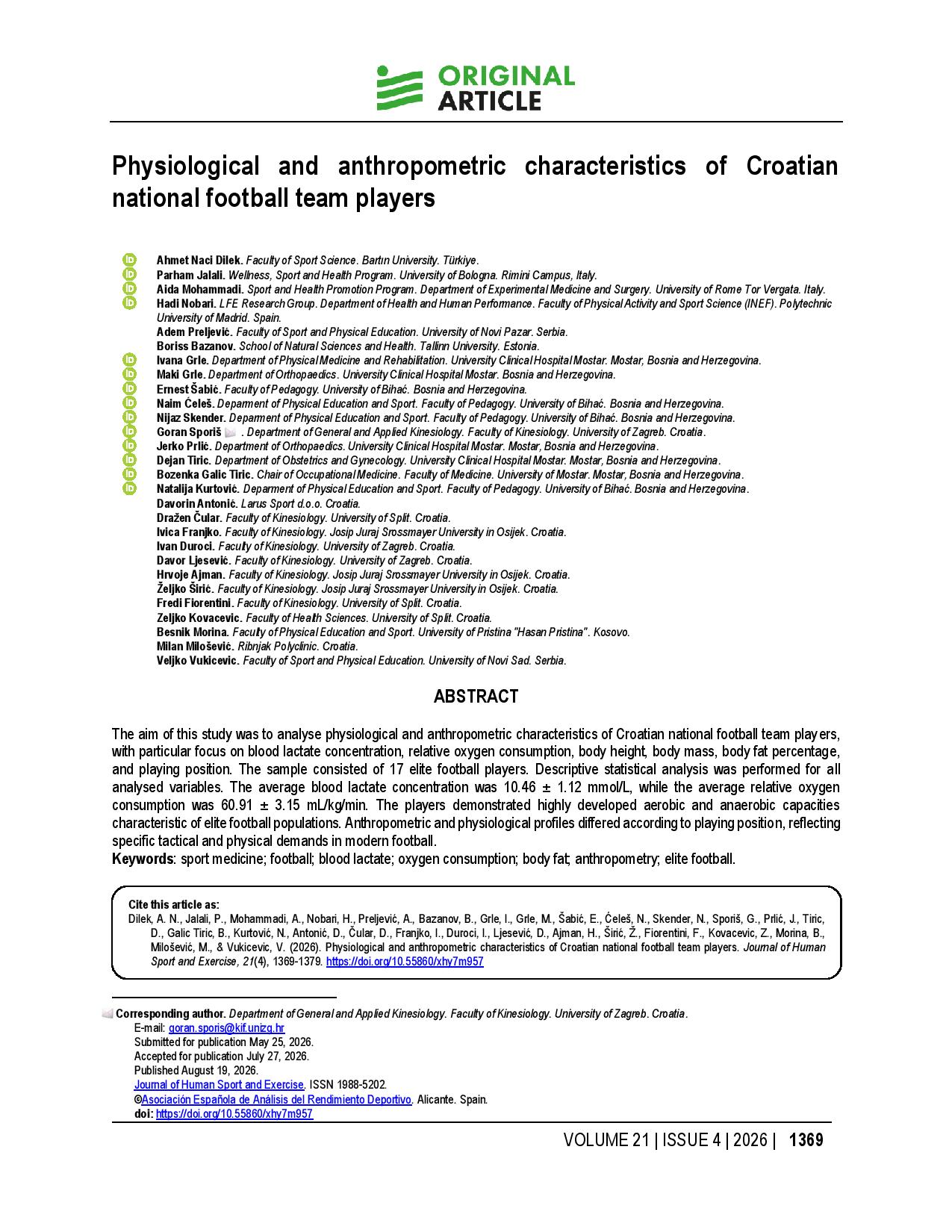
Physiological and anthropometric characteristics of Croatian national football team players
Article Sidebar
Main Article Content
Abstract
The aim of this study was to analyse physiological and anthropometric characteristics of Croatian national football team players, with particular focus on blood lactate concentration, relative oxygen consumption, body height, body mass, body fat percentage, and playing position. The sample consisted of 17 elite football players. Descriptive statistical analysis was performed for all analysed variables. The average blood lactate concentration was 10.46 ± 1.12 mmol/L, while the average relative oxygen consumption was 60.91 ± 3.15 mL/kg/min. The players demonstrated highly developed aerobic and anaerobic capacities characteristic of elite football populations. Anthropometric and physiological profiles differed according to playing position, reflecting specific tactical and physical demands in modern football.
Downloads
Article Details
Section

This work is licensed under a Creative Commons Attribution-NonCommercial-ShareAlike 4.0 International License.
Each author warrants that his or her submission to the Work is original and that he or she has full power to enter into this agreement. Neither this Work nor a similar work has been published elsewhere in any language nor shall be submitted for publication elsewhere while under consideration by Journal of Human Sport and Exercise (JHSE). Each author also accepts that the JHSE will not be held legally responsible for any claims of compensation.
Authors wishing to include figures or text passages that have already been published elsewhere are required to obtain permission from the copyright holder(s) and to include evidence that such permission has been granted when submitting their papers. Any material received without such evidence will be assumed to originate from the authors.
Please include at the end of the acknowledgements a declaration that the experiments comply with the current laws of the country in which they were performed. The editors reserve the right to reject manuscripts that do not comply with the abovementioned requirements. The author(s) will be held responsible for false statements or failure to fulfill the above-mentioned requirements.
This title is licensed under a Attribution-NonCommercial-ShareAlike 4.0 International (CC BY-NC-SA 4.0).
You are free to:
Share — copy and redistribute the material in any medium or format.
Adapt — remix, transform, and build upon the material.
The licensor cannot revoke these freedoms as long as you follow the license terms.
Under the following terms:
-
Attribution — You must give appropriate credit, provide a link to the license, and indicate if changes were made. You may do so in any reasonable manner, but not in any way that suggests the licensor endorses you or your use.
-
NonCommercial — You may not use the material for commercial purposes.
-
ShareAlike — If you remix, transform, or build upon the material, you must distribute your contributions under the same license as the original.
- No additional restrictions — You may not apply legal terms or technological measures that legally restrict others from doing anything the license permits.
Notices:
- You do not have to comply with the license for elements of the material in the public domain or where your use is permitted by an applicable exception or limitation.
- No warranties are given. The license may not give you all of the permissions necessary for your intended use. For example, other rights such as publicity, privacy, or moral rights may limit how you use the material.
How to Cite




References
Bangsbo, J., Mohr, M., & Krustrup, P. (2022). Physical and metabolic demands of football. Journal of Sports Sciences, 40(5), 523–536.
Bassett, D. R., Jr., & Howley, E. T. (2000). Limiting factors for maximum oxygen uptake and determinants of endurance performance. Medicine & Science in Sports & Exercise, 32(1), 70–84. https://doi.org/10.1097/00005768-200001000-00012 DOI: https://doi.org/10.1097/00005768-200001000-00012
Brooks, G. A. (2023). Lactate metabolism in exercise physiology. Cell Metabolism, 35(4), 567–580.
Castagna, C., Impellizzeri, F., & Rampinini, E. (2022). Anthropometric and physiological characteristics in elite football players. Journal of Sports Sciences, 40(11), 1204–1213.
Impellizzeri, F., Marcora, S., & Castagna, C. (2023). Physiological conditioning in elite football. Sports Medicine, 53(6), 1111–1125.
Jovanović, M., Sporiš, G., Omrčen, D., & Fiorentini, F. (2011). Effects of speed, agility, quickness training method on power performance in elite soccer players. Journal of Strength and Conditioning Research, 25(5), 1285–1292. https://doi.org/10.1519/JSC.0b013e3181d67c65 DOI: https://doi.org/10.1519/JSC.0b013e3181d67c65
Milanović, Z., Pantelić, S., Čović, N., Sporiš, G., & Krustrup, P. (2015). Is recreational soccer effective for improving physical fitness? A systematic review and meta-analysis. Sports Medicine, 45(9), 1339–1353. https://doi.org/10.1007/s40279-015-0361-4 DOI: https://doi.org/10.1007/s40279-015-0361-4
Milanović, Z., Sporiš, G., Trajković, N., James, N., & Šamija, K. (2013). Effects of a 12 week SAQ training programme on agility with and without the ball among young soccer players. Journal of Sports Science and Medicine, 12(1), 97–103. https://www.jssm.org/jssm-12-97.xml-Fulltext
Reilly, T., Bangsbo, J., & Franks, A. (2022). Anthropometric predispositions for elite football performance. European Journal of Sport Science, 22(8), 1181–1192.
Sporiš, G., Čanaki, M., & Barišić, V. (2007). Morphological differences of elite Croatian female soccer players according to team position. Hrvatski Športskomedicinski Vjesnik, 22(2), 91–96. https://hrcak.srce.hr/20122
Sporiš, G., Jovanović, M., Omrčen, D., & Matković, B. (2011a). Can the official soccer game be considered the most important contribution to player physical fitness level? Journal of Sports Medicine and Physical Fitness, 51(3), 374–380.
Sporiš, G., Jukić, I., Milanović, L., & Vučetić, V. (2010a). Reliability and factorial validity of agility tests for soccer players. Journal of Strength and Conditioning Research, 24(3), 679–686. https://doi.org/10.1519/JSC.0b013e3181c4d324 DOI: https://doi.org/10.1519/JSC.0b013e3181c4d324
Sporiš, G., Jukić, I., Ostojić, S. M., & Milanović, D. (2009). Fitness profiling in soccer: Physical and physiologic characteristics of elite players. Journal of Strength and Conditioning Research, 23(7), 1947–1953. https://doi.org/10.1519/JSC.0b013e3181b3e141 DOI: https://doi.org/10.1519/JSC.0b013e3181b3e141
Sporiš, G., Milanović, Z., Trajković, N., & Joksimović, A. (2011b). Correlation between speed, agility and quickness performance and anthropometric characteristics in elite young soccer players. Collegium Antropologicum, 35(2), 599–605.
Sporiš, G., Ružić, L., & Leko, G. (2008). The anaerobic endurance of elite soccer players improved after a high-intensity training intervention in the 8-week conditioning program. Journal of Strength and Conditioning Research, 22(2), 559–566. https://doi.org/10.1519/JSC.0b013e3181660401 DOI: https://doi.org/10.1519/JSC.0b013e3181660401
Sporiš, G., Vučetić, V., Milanović, L., Milanović, Z., Krespi, M., & Krakan, I. (2014). A comparison anaerobic endurance capacity in elite soccer, handball and basketball players. Kinesiology, 46(Suppl. 1), 52–59. https://hrcak.srce.hr/127843
Stølen, T., Chamari, K., Castagna, C., & Wisløff, U. (2022). Physiology of football: Updated perspectives. European Journal of Sport Science, 22(7), 1045–1058.