The effect of modified brain break warm-up on executive functions, attentional refocusing, and mood states in collegiate e-sports players An exploratory proof-of-concept randomized controlled trial
Article Sidebar
Main Article Content
Abstract
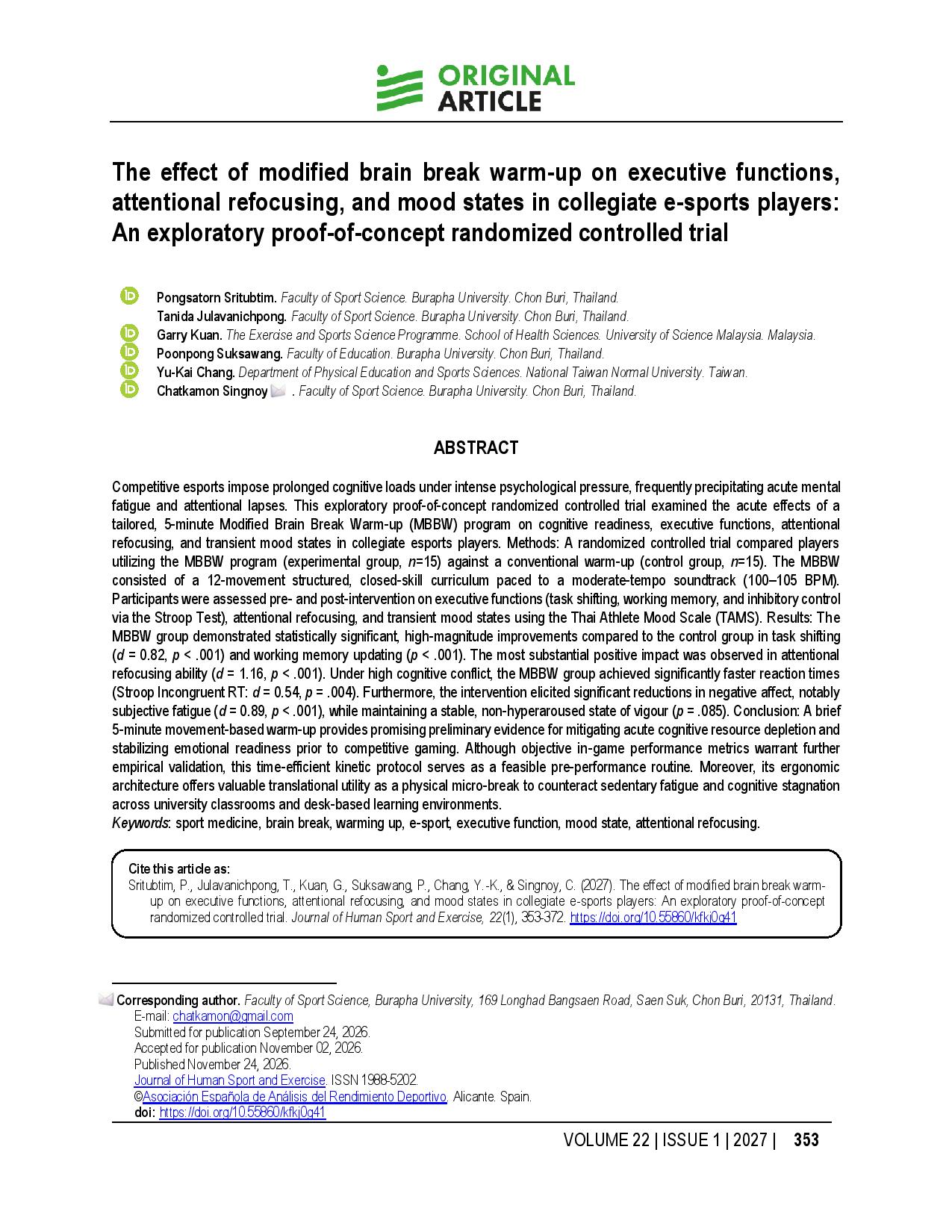
Competitive esports impose prolonged cognitive loads under intense psychological pressure, frequently precipitating acute mental fatigue and attentional lapses. This exploratory proof-of-concept randomized controlled trial examined the acute effects of a tailored, 5-minute Modified Brain Break Warm-up (MBBW) program on cognitive readiness, executive functions, attentional refocusing, and transient mood states in collegiate esports players. Methods: A randomized controlled trial compared players utilizing the MBBW program (experimental group, n=15) against a conventional warm-up (control group, n=15). The MBBW consisted of a 12-movement structured, closed-skill curriculum paced to a moderate-tempo soundtrack (100–105 BPM). Participants were assessed pre- and post-intervention on executive functions (task shifting, working memory, and inhibitory control via the Stroop Test), attentional refocusing, and transient mood states using the Thai Athlete Mood Scale (TAMS). Results: The MBBW group demonstrated statistically significant, high-magnitude improvements compared to the control group in task shifting (d = 0.82, p < .001) and working memory updating (p < .001). The most substantial positive impact was observed in attentional refocusing ability (d = 1.16, p < .001). Under high cognitive conflict, the MBBW group achieved significantly faster reaction times (Stroop Incongruent RT: d = 0.54, p = .004). Furthermore, the intervention elicited significant reductions in negative affect, notably subjective fatigue (d = 0.89, p < .001), while maintaining a stable, non-hyperaroused state of vigour (p = .085). Conclusion: A brief 5-minute movement-based warm-up provides promising preliminary evidence for mitigating acute cognitive resource depletion and stabilizing emotional readiness prior to competitive gaming. Although objective in-game performance metrics warrant further empirical validation, this time-efficient kinetic protocol serves as a feasible pre-performance routine. Moreover, its ergonomic architecture offers valuable translational utility as a physical micro-break to counteract sedentary fatigue and cognitive stagnation across university classrooms and desk-based learning environments.
Downloads
Article Details
Section

This work is licensed under a Creative Commons Attribution-NonCommercial-ShareAlike 4.0 International License.
Each author warrants that his or her submission to the Work is original and that he or she has full power to enter into this agreement. Neither this Work nor a similar work has been published elsewhere in any language nor shall be submitted for publication elsewhere while under consideration by Journal of Human Sport and Exercise (JHSE). Each author also accepts that the JHSE will not be held legally responsible for any claims of compensation.
Authors wishing to include figures or text passages that have already been published elsewhere are required to obtain permission from the copyright holder(s) and to include evidence that such permission has been granted when submitting their papers. Any material received without such evidence will be assumed to originate from the authors.
Please include at the end of the acknowledgements a declaration that the experiments comply with the current laws of the country in which they were performed. The editors reserve the right to reject manuscripts that do not comply with the abovementioned requirements. The author(s) will be held responsible for false statements or failure to fulfill the above-mentioned requirements.
This title is licensed under a Attribution-NonCommercial-ShareAlike 4.0 International (CC BY-NC-SA 4.0).
You are free to:
Share — copy and redistribute the material in any medium or format.
Adapt — remix, transform, and build upon the material.
The licensor cannot revoke these freedoms as long as you follow the license terms.
Under the following terms:
-
Attribution — You must give appropriate credit, provide a link to the license, and indicate if changes were made. You may do so in any reasonable manner, but not in any way that suggests the licensor endorses you or your use.
-
NonCommercial — You may not use the material for commercial purposes.
-
ShareAlike — If you remix, transform, or build upon the material, you must distribute your contributions under the same license as the original.
- No additional restrictions — You may not apply legal terms or technological measures that legally restrict others from doing anything the license permits.
Notices:
- You do not have to comply with the license for elements of the material in the public domain or where your use is permitted by an applicable exception or limitation.
- No warranties are given. The license may not give you all of the permissions necessary for your intended use. For example, other rights such as publicity, privacy, or moral rights may limit how you use the material.
How to Cite




References
Albulescu, P., Macsinga, I., Rusu, A., Sulea, C., Bodnaru, A., & Tulbure, B. T. (2022). “Give me a break!” A systematic review and meta-analysis on the efficacy of micro-breaks for increasing well-being and performance. PLOS ONE, 17(8), e0272460. https://doi.org/10.1371/journal.pone.0272460 DOI: https://doi.org/10.1371/journal.pone.0272460
Barney, D. C., Pleban, F. T., & Gishe, J. (2021). Effects of music on mood during basketball play in junior high school physical education. The Physical Educator, 78(1), 31–43. https://doi.org/10.18666/TPE-2021-V78-I1-10395 DOI: https://doi.org/10.18666/TPE-2021-V78-I1-10395
Blacker, K. J., & Curby, K. M. (2013). Enhanced visual short-term memory in action video game players. Attention, Perception, & Psychophysics, 75(6), 1128–1136. https://doi.org/10.3758/s13414-013-0487-0 DOI: https://doi.org/10.3758/s13414-013-0487-0
Blacker, K. J., Curby, K. M., Klobusicky, E., & Chein, J. M. (2014). Effects of action video game training on visual working memory. Journal of Experimental Psychology: Human Perception and Performance, 40(5), 1992–2004. https://doi.org/10.1037/a0037556 DOI: https://doi.org/10.1037/a0037556
Blasche, G., Szabo, B., Wagner-Menghin, M., Ekmekcioglu, C., & Gollner, E. (2018). Comparison of rest break interventions during a mentally demanding task. Stress and Health, 34(5), 629–638. https://doi.org/10.1002/smi.2825 DOI: https://doi.org/10.1002/smi.2830
Brisswalter, J., Collardeau, M., & René, A. (2002). Effects of acute physical exercise characteristics on cognitive performance. Sports Medicine, 32(9), 555–566. https://doi.org/10.2165/00007256-200232090-00002 DOI: https://doi.org/10.2165/00007256-200232090-00002
Cain, M. S., Landau, A. N., & Shimamura, A. P. (2012). Action video game experience reduces the cost of switching tasks. Attention, Perception, & Psychophysics, 74(4), 641–647. https://doi.org/10.3758/s13414-012-0284-1 DOI: https://doi.org/10.3758/s13414-012-0284-1
Caine, R. N., & Caine, G. (1991). Making connections: Teaching and the human brain. Association for Supervision and Curriculum Development.
Chang, Y.-K., Tsai, C.-L., Hung, T.-M., So, E. C., Chen, F.-T., & Etnier, J. L. (2011). Effects of acute exercise on executive function: A study with a Tower of London task. Journal of Sport and Exercise Psychology, 33(6), 847–865. https://doi.org/10.1123/jsep.33.6.847 DOI: https://doi.org/10.1123/jsep.33.6.847
Chisholm, J. D., Hickey, C., Theeuwes, J., & Kingstone, A. (2010). Reduced attentional capture in action video game players. Attention, Perception, & Psychophysics, 72(3), 667–671. https://doi.org/10.3758/APP.72.3.667 DOI: https://doi.org/10.3758/APP.72.3.667
Colzato, L. S., van den Wildenberg, W. P., Zmigrod, S., & Hommel, B. (2013). Action video gaming and cognitive control: Playing first person shooter games is associated with improvement in working memory but not action inhibition. Psychological Research, 77(2), 234–239. https://doi.org/10.1007/s00426-012-0415-2 DOI: https://doi.org/10.1007/s00426-012-0415-2
Damasio, A. (2000). A second chance for emotion: Cognitive neuroscience of emotion. Oxford University Press. https://doi.org/10.1093/oso/9780195118889.003.0002 DOI: https://doi.org/10.1093/oso/9780195118889.003.0002
Dennison, P. E., & Dennison, G. E. (1997). Brain gym: Teacher's edition. Edu-Kinesthetics, Inc.
Desautels, L. (2016). How emotions affect learning, behaviors, and relationships. Edutopia.
DiFrancisco-Donoghue, J., Balentine, J., Schmidt, G., & Zwibel, H. (2019). Managing the health of the eSport athlete: An integrated health management model. BMJ Open Sport & Exercise Medicine, 5(1), e000467. https://doi.org/10.1136/bmjsem-2018-000467 DOI: https://doi.org/10.1136/bmjsem-2018-000467
Dijksterhuis, A., Bos, M. W., Nordgren, L. F., & Van Baaren, R. B. (2006). On making the right choice: The deliberation-without-attention effect. Science, 311(5763), 1005–1007. https://doi.org/10.1126/science.1121629 DOI: https://doi.org/10.1126/science.1121629
Ferrer, M. E., & Laughlin, D. D. (2017). Increasing college students' engagement and physical activity with classroom brain breaks. Journal of Physical Education, Recreation & Dance, 88(3), 53–56. https://doi.org/10.1080/07303084.2017.1280439 DOI: https://doi.org/10.1080/07303084.2017.1260945
Godwin, K. E., Almeda, M. V., Seltman, H., Kai, S., Skerbetz, M. D., Baker, R. S., & Fisher, A. V. (2016). Off-task behavior in elementary school children. Learning and Instruction, 44, 128–143. https://doi.org/10.1016/j.learninstruc.2016.04.003 DOI: https://doi.org/10.1016/j.learninstruc.2016.04.003
Gong, D., Ma, W., Liu, T., Yan, Y., & Yao, D. (2019). Electronic-sports experience related to functional enhancement in central executive and default mode areas. Neural Plasticity, 2019, Article 1940123. https://doi.org/10.1155/2019/1940123 DOI: https://doi.org/10.1155/2019/1940123
Green, C. S., & Bavelier, D. (2003). Action video game modifies visual selective attention. Nature, 423(6939), 534–537. https://doi.org/10.1038/nature01647 DOI: https://doi.org/10.1038/nature01647
Green, C. S., & Bavelier, D. (2006). Effect of action video games on the spatial distribution of visuospatial attention. Journal of Experimental Psychology: Human Perception and Performance, 32(6), 1465–1478. https://doi.org/10.1037/0096-1523.32.6.1465 DOI: https://doi.org/10.1037/0096-1523.32.6.1465
Gu, Q., Zou, L., Loprinzi, P. D., Quan, M., & Huang, T. (2019). Effects of open versus closed skill exercise on cognitive function: A systematic review. Frontiers in Psychology, 10, Article 1707. https://doi.org/10.3389/fpsyg.2019.01707 DOI: https://doi.org/10.3389/fpsyg.2019.01707
Hagiwara, G., Akiyama, D., & Takeshita, S. (2019). Examining effectiveness of e-sports activity in Japan. Journal of Digital Life, 1, 1–10. https://doi.org/10.14198/jhse.2019.14.Proc4.66 DOI: https://doi.org/10.14198/jhse.2019.14.Proc4.66
Hwu, M. (2018). 1HP Medkit: Low back pain in gaming - What is it and how do we address it? 1HP.
Immordino-Yang, M. H., & Damasio, A. (2007). We feel, therefore we learn: The relevance of affective and social neuroscience to education. Mind, Brain, and Education, 1(1), 3–10. https://doi.org/10.1111/j.1744-6198.2007.00063.x DOI: https://doi.org/10.1111/j.1751-228X.2007.00004.x
Jensen, E. (2001). Arts with the brain in mind. Association for Supervision and Curriculum Development.
Jensen, E. (2005a). Teaching with the brain in mind. Association for Supervision and Curriculum Development.
Jensen, E. (2008). Brain-based learning: The new paradigm of teaching (2nd ed.). Corwin Press.
Karageorghis, C. I., Jones, L., & Low, D. C. (2006). Relationship between exercise heart rate and music tempo preference. Research Quarterly for Exercise and Sport, 77(2), 240–250. https://doi.org/10.1080/02701367.2006.10599357 DOI: https://doi.org/10.1080/02701367.2006.10599357
Keating, R., Ahern, S., Bisgood, L., Mernagh, K., Nicolson, G. H., & Barrett, E. M. (2022). Stand up, stand out: Feasibility of an active break targeting prolonged sitting in university students. Journal of American College Health, 70(7), 2237–2243. https://doi.org/10.1080/07448481.2020.1847119 DOI: https://doi.org/10.1080/07448481.2020.1847119
Kendal, K., Ataç, A., & Köse, İ. T. (2022). Effects of game addiction on musculoskeletal system discomfort and mental toughness in e-sport players. ADDICTA: The Turkish Journal on Addictions, 9(2), 164–171. https://doi.org/10.5152/ADDICTA.2021.21079 DOI: https://doi.org/10.5152/ADDICTA.2021.21079
Kuan, G., Rizal, H., Hajar, M. S., Chin, M. K., & Mok, M. M. C. (2019). Bright sports, physical activity investments that work: Implementing brain breaks in Malaysian primary schools. British Journal of Sports Medicine, 53(14), 905–906. https://doi.org/10.1136/bjsports-2018-099411 DOI: https://doi.org/10.1136/bjsports-2018-100146
Kuczala, M. (2015). Training in motion: How to use movement to create engaging and effective learning. AMACOM.
Lengel, T., & Kuczala, M. (2010). The kinesthetic classroom: Teaching and learning through movement. Corwin Press. https://doi.org/10.65528/9780807784068-012 DOI: https://doi.org/10.65528/9780807784068-012
Lopes de Lima, C. Z., de Sousa Fortes, L., Pires, D. A., Souza Machado, H. E., Socorro Dantas Oliveira, A. D., Coswig, V. S., & Penna, E. M. (2025). Mental fatigue increases perception of effort but does not compromise the inhibitory control of football referees during a match simulation physical task. European Journal of Sport Science, 25(3), e12222. https://doi.org/10.1002/ejsc.12222 DOI: https://doi.org/10.1002/ejsc.12222
Lynch, J., O'Donoghue, G., & Peiris, C. L. (2022). Classroom movement breaks and physically active learning are feasible, reduce sedentary behaviour and fatigue, and may increase focus in university students: A systematic review and meta-analysis. International Journal of Environmental Research and Public Health, 19(13), Article 7775. https://doi.org/10.3390/ijerph19137775 DOI: https://doi.org/10.3390/ijerph19137775
Maskell, B., Shapiro, D. R., & Ridley, C. (2004). Effects of Brain Gym on overhand throwing in first grade students: A preliminary investigation. The Physical Educator, 61(1), 14–23.
Materna, L. (2007). Jump-start the adult learner: How to engage and motivate adults using brain-compatible strategies. Corwin Press.
McMorris, T., & Graydon, J. (2000). The effect of incremental exercise on cognitive performance. International Journal of Sport Psychology, 31(1), 66–81.
Moreira, A., Aoki, M. S., Franchini, E., da Silva Machado, D. G., Paludo, A. C., & Okano, A. H. (2018). Mental fatigue impairs technical performance and alters neuroendocrine and autonomic responses in elite young basketball players. Physiology & Behavior, 196, 112–118. https://doi.org/10.1016/j.physbeh.2018.08.015 DOI: https://doi.org/10.1016/j.physbeh.2018.08.015
Morton, S. F. (2016). Engagement through brain breaks in the secondary classroom [Unpublished doctoral dissertation]. University of Missouri-St. Louis.
Paulus, M., Kunkel, J., Schmidt, S. C., Bachert, P., Wäsche, H., Neumann, R., & Woll, A. (2021). Standing breaks in lectures improve university students' self-perceived physical, mental, and cognitive condition. International Journal of Environmental Research and Public Health, 18(8), Article 4204. https://doi.org/10.3390/ijerph18084204 DOI: https://doi.org/10.3390/ijerph18084204
Peiris, C. L., O'Donoghue, G., Rippon, L., Meyers, D., Hahne, A., De Noronha, M., . . . Hanson, L. C. (2021). Classroom movement breaks reduce sedentary behavior and increase concentration, alertness and enjoyment during university classes: A mixed-methods feasibility study. International Journal of Environmental Research and Public Health, 18(11), Article 5589. https://doi.org/10.3390/ijerph18115589 DOI: https://doi.org/10.3390/ijerph18115589
Priest, D. L., Karageorghis, C. I., & Sharp, N. C. (2004). The characteristics and effects of motivational music in exercise settings: The possible influence of gender, age, frequency of attendance, and time of attendance. Journal of Sports Medicine and Physical Fitness, 44(1), 77–86.
Reilly, E., Buskist, C., & Gross, M. K. (2012). Movement in the classroom: Boosting brain power, fighting obesity. Kappa Delta Pi Record, 48(3), 62–66. https://doi.org/10.1080/00228958.2012.707501 DOI: https://doi.org/10.1080/00228958.2012.680365
Rice, G. T. (2023). Hitting pause: 65 lecture breaks to refresh and reinforce learning. Taylor & Francis. https://doi.org/10.4324/9781003445128 DOI: https://doi.org/10.4324/9781003445128
Stevens-Smith, D. A. (2016). Active bodies/active brains: Practical applications using physical engagement to enhance brain development. Strategies, 29(6), 3–7. https://doi.org/10.1080/08924562.2016.1231098 DOI: https://doi.org/10.1080/08924562.2016.1231096
Stone, J. (2015). Effectiveness of brain breaks on concentration and ability to answer higher order questions in a 7th grade language arts class [Master's thesis]. William Paterson University of New Jersey.
Sudo, M., & Ando, S. (2020). Effects of acute stretching on cognitive function and mood states of physically inactive young adults. Perceptual and Motor Skills, 127(1), 142–153. https://doi.org/10.1177/0031512519888304 DOI: https://doi.org/10.1177/0031512519888304
Sun, H., Soh, K. G., Roslan, S., Wazir, M. R. W. N., & Soh, K. L. (2021). Does mental fatigue affect skilled performance in athletes? A systematic review. PLOS ONE, 16(10), e0258307. https://doi.org/10.1371/journal.pone.0258307 DOI: https://doi.org/10.1371/journal.pone.0258307
Swan, M. (2019, July). What is brain-based learning? Classcraft.
Tomporowski, P. D. (2003). Effects of acute bouts of exercise on cognition. Acta Psychologica, 112(3), 297–324. https://doi.org/10.1016/S0001-6918(02)00134-8 DOI: https://doi.org/10.1016/S0001-6918(02)00134-8
Tomporowski, P. D., & Ellis, N. R. (1986). Effects of exercise on cognitive processes: A review. Psychological Bulletin, 99(3), 338–346. https://doi.org/10.1037/0033-2909.99.3.338 DOI: https://doi.org/10.1037/0033-2909.99.3.338
Thomson, D. R., Seli, P., & Smilek, D. (2015). Rest and recovery: The role of the default mode network. Neuroscience & Biobehavioral Reviews, 51, 13–27. https://doi.org/10.1016/j.neubiorev.2015.01.008 DOI: https://doi.org/10.1016/j.neubiorev.2015.01.008
Weslake, A., & Christian, B. J. (2015). Brain breaks: Help or hindrance? TEACH Collection of Christian Education, 1(1), Article 4.
White, C., & Smith, L. (2020). Dramatic engagers: Games, creative activities, & brain breaks for social & emotional learning & academic achievement. AuthorHouse.
Yu, Q., Zhang, Z., Ludyga, S., Erickson, K. I., Cheval, B., Hou, M., Pindus, D. M., Hillman, C. H., Kramer, A. F., Falck, R. S., Liu-Ambrose, T., Kuang, J., Mullen, S. P., Kamijo, K., Ishihara, T., Raichlen, D. A., Heath, M., Moreau, D., Werneck, A. O., Herold, F., & Zou, L. (2025). Effects of physical exercise breaks on executive function in a simulated classroom setting: Uncovering a window into the brain. Advanced Science, 12(3), Article e2406631. https://doi.org/10.1002/advs.202406631 DOI: https://doi.org/10.1002/advs.202406631
Zanini, G. S., Pessôa Filho, D. M., Neiva, C. M., Da Silva, D. P., Ciolac, E. G., & Verardi, C. E. L. (2018). Stress and mood states monitoring in a swimming team during a competitive period. Journal of Physical Education and Sport, 18(4), 2466–2471. https://doi.org/10.7752/jpes.2018.04371 DOI: https://doi.org/10.7752/jpes.2018.04369