Triadic assessment of oral presentations in higher education Convergence between self-, peer- and teacher assessment according to academic performance
Article Sidebar
Main Article Content
Abstract
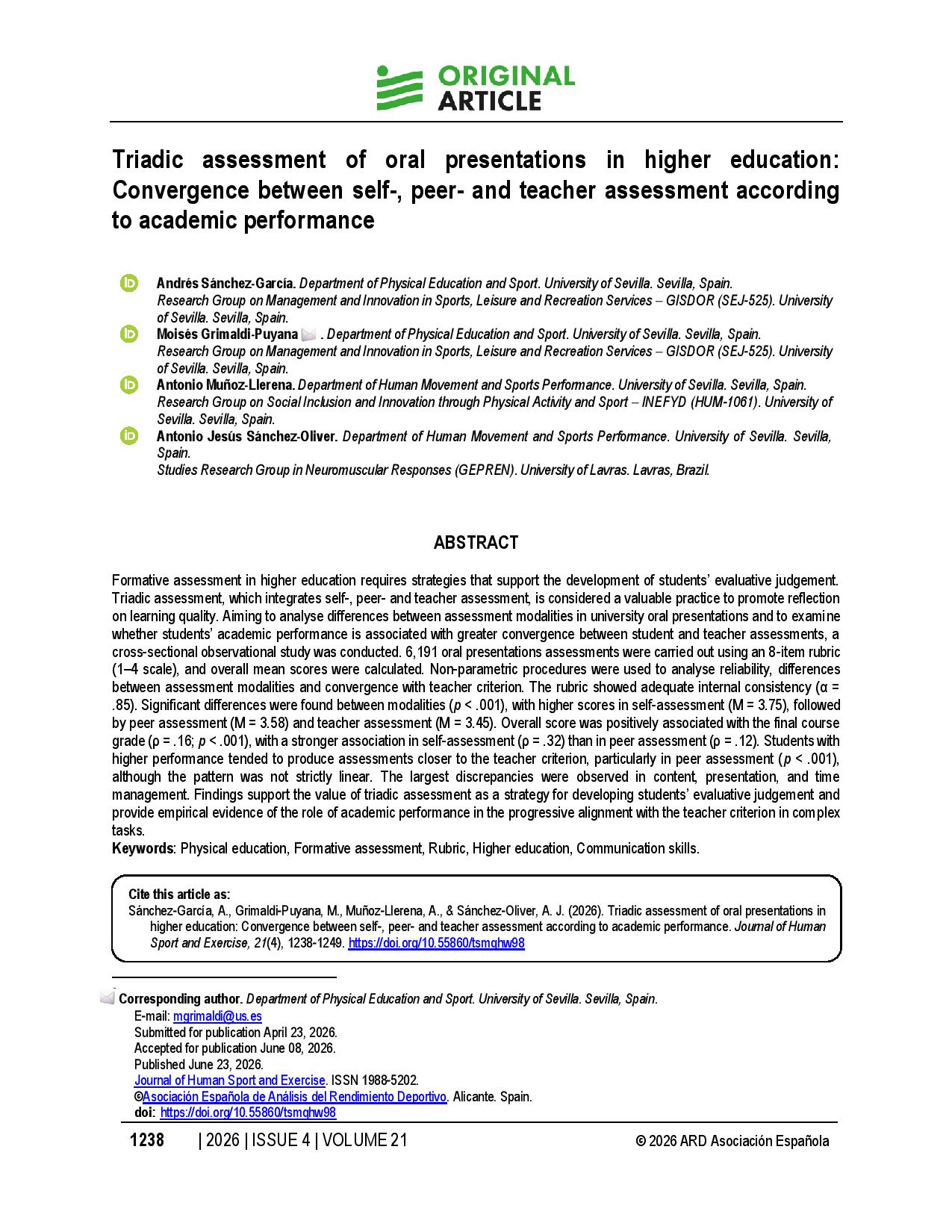
Formative assessment in higher education requires strategies that support the development of students’ evaluative judgement. Triadic assessment, which integrates self-, peer- and teacher assessment, is considered a valuable practice to promote reflection on learning quality. Aiming to analyse differences between assessment modalities in university oral presentations and to examine whether students’ academic performance is associated with greater convergence between student and teacher assessments, a cross-sectional observational study was conducted. 6,191 oral presentations assessments were carried out using an 8-item rubric (1–4 scale), and overall mean scores were calculated. Non-parametric procedures were used to analyse reliability, differences between assessment modalities and convergence with teacher criterion. The rubric showed adequate internal consistency (α = .85). Significant differences were found between modalities (p < .001), with higher scores in self-assessment (M = 3.75), followed by peer assessment (M = 3.58) and teacher assessment (M = 3.45). Overall score was positively associated with the final course grade (ρ = .16; p < .001), with a stronger association in self-assessment (ρ = .32) than in peer assessment (ρ = .12). Students with higher performance tended to produce assessments closer to the teacher criterion, particularly in peer assessment (p < .001), although the pattern was not strictly linear. The largest discrepancies were observed in content, presentation, and time management. Findings support the value of triadic assessment as a strategy for developing students’ evaluative judgement and provide empirical evidence of the role of academic performance in the progressive alignment with the teacher criterion in complex tasks.
Downloads
Article Details
Section

This work is licensed under a Creative Commons Attribution-NonCommercial-ShareAlike 4.0 International License.
Each author warrants that his or her submission to the Work is original and that he or she has full power to enter into this agreement. Neither this Work nor a similar work has been published elsewhere in any language nor shall be submitted for publication elsewhere while under consideration by Journal of Human Sport and Exercise (JHSE). Each author also accepts that the JHSE will not be held legally responsible for any claims of compensation.
Authors wishing to include figures or text passages that have already been published elsewhere are required to obtain permission from the copyright holder(s) and to include evidence that such permission has been granted when submitting their papers. Any material received without such evidence will be assumed to originate from the authors.
Please include at the end of the acknowledgements a declaration that the experiments comply with the current laws of the country in which they were performed. The editors reserve the right to reject manuscripts that do not comply with the abovementioned requirements. The author(s) will be held responsible for false statements or failure to fulfill the above-mentioned requirements.
This title is licensed under a Attribution-NonCommercial-ShareAlike 4.0 International (CC BY-NC-SA 4.0).
You are free to:
Share — copy and redistribute the material in any medium or format.
Adapt — remix, transform, and build upon the material.
The licensor cannot revoke these freedoms as long as you follow the license terms.
Under the following terms:
-
Attribution — You must give appropriate credit, provide a link to the license, and indicate if changes were made. You may do so in any reasonable manner, but not in any way that suggests the licensor endorses you or your use.
-
NonCommercial — You may not use the material for commercial purposes.
-
ShareAlike — If you remix, transform, or build upon the material, you must distribute your contributions under the same license as the original.
- No additional restrictions — You may not apply legal terms or technological measures that legally restrict others from doing anything the license permits.
Notices:
- You do not have to comply with the license for elements of the material in the public domain or where your use is permitted by an applicable exception or limitation.
- No warranties are given. The license may not give you all of the permissions necessary for your intended use. For example, other rights such as publicity, privacy, or moral rights may limit how you use the material.
How to Cite




Funding data
-
Universidad de Sevilla
Grant numbers Action 221
References
Basurto-Mendoza, S. T., Moreira-Cedeño, J. A., Velásquez-Espinales, A. N., & Rodríguez-Gámez, M. (2021). Autoevaluación, Coevaluación y Heteroevaluación como enfoque innovador en la práctica pedagógica y su efecto en el proceso de enseñanza-aprendizaje. Polo del Conocimiento, 6(3), 828-845.
Boud, D., & Falchikov, N. (Eds.). (2007). Rethinking assessment in higher education: Learning for the longer term. Routledge. https://doi.org/10.4324/9780203964309 DOI: https://doi.org/10.4324/9780203964309
Boud, D., & Soler, R. (2016). Sustainable assessment revisited. Assessment & Evaluation in Higher Education, 41(3), 400-413. https://doi.org/10.1080/02602938.2015.1018133 DOI: https://doi.org/10.1080/02602938.2015.1018133
Boud, D., Ajjawi, R., Dawson, P., & Tai, J. (Eds.). (2018). Developing evaluative judgement in higher education: Assessment for knowing and producing quality work. Routledge. https://doi.org/10.4324/9781315109251 DOI: https://doi.org/10.4324/9781315109251
Bozkurt, F. (2020). Teacher candidates' views on self and peer assessment as a tool for student development. Australian Journal of Teacher Education, 45 (1). https://doi.org/10.14221/ajte.2020v45n1.4 DOI: https://doi.org/10.14221/ajte.2020v45n1.4
Castejón, F. J., Santos Pastor, M., & Cañadas, L. (2018). Desarrollo de competencias docentes en la Formación Inicial del Profesorado de Educación Física. Relación con los instrumentos de evaluación. Estudios Pedagógicos (Valdivia), 44(2), 111-126. https://doi.org/10.4067/S0718-07052018000200111 DOI: https://doi.org/10.4067/S0718-07052018000200111
Chireac, S. M., & Martín-Vegas, R. A. (2022). A bibliometric analysis of the Spanish scientific production on teaching oral communication between 2010 and 2020. TEM Journal, 11(4), 1620-1625. https://doi.org/10.18421/TEM114-24 DOI: https://doi.org/10.18421/TEM114-24
Falchikov, N., & Goldfinch, J. (2000). Student peer assessment in higher education: A meta-analysis comparing peer and teacher marks. Review of Educational Research, 70(3), 287-322. https://doi.org/10.3102/00346543070003287 DOI: https://doi.org/10.3102/00346543070003287
Fernández García, C. M., Torío López, S., Viñuela Hernández, M. P., Molina Martín, S., y Bermúdez Rey, T. (2008). La comunicación oral como competencia transversal de los estudiantes de pedagogía y magisterio: Presentación del diseño metodológico de una innovación para su trabajo en el aula. Revista de Enseñanza Universitaria, 31, 26-38.
Gale, K., Martin, K., & McQueen, G. (2002). Triadic assessment. Assessment & Evaluation in Higher Education, 27(6), 557-567. https://doi.org/10.1080/0260293022000020318 DOI: https://doi.org/10.1080/0260293022000020318
Hattie, J., & Timperley, H. (2007). The power of feedback. Review of Educational Research, 77(1), 81-112. https://doi.org/10.3102/003465430298487 DOI: https://doi.org/10.3102/003465430298487
Kambourova, M., Gónzalez-Agudelo, E. M., & Grisales-Franco, L. M. (2021). La autoevaluación del estudiante universitario: revisión de la literatura. Teoría de la Educación: Revista Interuniversitaria: 33, 2, 2021, 217-264. https://doi.org/10.14201/teri.23672 DOI: https://doi.org/10.14201/teri.23672
López Pastor, V. M., & Pérez Pueyo, Á. (2017). Introducción a la creación y el uso de escalas descriptivas y rúbricas. En V. M. López Pastor & Á. Pérez Pueyo (Coords.), Evaluación formativa y compartida en educación: Experiencias de éxito en todas las etapas educativas (pp. 92-115). Universidad de León.
McConlogue, T. (2020). Assessment and feedback in higher education: A guide for teachers. UCL Press.
Mendoza, S. T. B., Cedeño, J. A. M., Espinales, A. N. V., & Gámez, M. R. (2021). Autoevaluación, Coevaluación y Heteroevaluación como enfoque innovador en la práctica pedagógica y su efecto en el proceso de enseñanza-aprendizaje. Polo del Conocimiento: Revista científico-profesional, 6(3),828-845.
Nicol, D. J., & Macfarlane Dick, D. (2006). Formative assessment and self regulated learning: A model and seven principles of good feedback practice. Studies in Higher Education, 31(2), 199-218. https://doi.org/10.1080/03075070600572090 DOI: https://doi.org/10.1080/03075070600572090
Olague, M. Z., Cañadas, L., & Manso, J. (2025). Percepción del profesorado de educación básica sobre la participación de los diferentes agentes (profesorado y alumnado) en los procesos de evaluación. Revista Fuentes, 27(3), 289-300. https://doi.org/10.12795/revistafuentes.2025.27856 DOI: https://doi.org/10.12795/revistafuentes.2025.27856
Panadero, E., & Jonsson, A. (2013). The use of scoring rubrics for formative assessment purposes revisited: A review. Educational Research Review, 9, 129-144. https://doi.org/10.1016/j.edurev.2013.01.002 DOI: https://doi.org/10.1016/j.edurev.2013.01.002
Pascual-Arias, C., López-Pastór, V. M., & Hórtiguela-Alcala, D. (2023). Estudió longitudinal sobre los efectos del desarrollo de la Evaluación Formativa y Compartida en la Formación Inicial del Profesorado. Cultura, Ciencia y Deporte, 18(55), 5-31. https://doi.org/10.12800/ccd.v18i55.1904 DOI: https://doi.org/10.12800/ccd.v18i55.1904
Reddy, Y. M., & Andrade, H. (2010). A review of rubric use in higher education. Assessment & Evaluation in Higher Education, 35(4), 435-448. https://doi.org/10.1080/02602930902862859 DOI: https://doi.org/10.1080/02602930902862859
Sánchez-García, A., Sanchez-Oliver, A. J., & Grimaldi-Puyana, M. (2026). Triadic formative assessment in higher education: interaction effects between assessment modality and evaluator sex. Retos, 77, 346-357. https://doi.org/10.47197/retos.v77.118382 DOI: https://doi.org/10.47197/retos.v77.118382
Sánchez-Oliver, A. J., Carnero-Díaz, Á., Muñoz-Llerena, A., & Bianchi, P. (2025). Proyecto de innovación docente para la implementación de la evaluación formativa en la universidad. In Acciones educativas innovadoras en el ámbito universitario (pp. 85-103). Dykinson.
Sánchez-Oliver, A. J., Rodríguez Rojas, F. J., Feria-Madueño, A., Muñoz-López, A., Carnero Díaz, Ángel, Muñoz-Llerena, A., Sañudo-Corrales, B., Oviedo-Caro, M. Ángel, Grimaldi-Puyana, M., Bianchi, P., Domínguez, R., & Angosto, S. (2025). Validation of a tool to evaluate theoretical-practical presentations in Higher Education. Retos, 67, 903-916. https://doi.org/10.47197/retos.v67.112987 DOI: https://doi.org/10.47197/retos.v67.112987
Sánchez-Oliver, A. J., Sánchez-García, A., Feria-Madueño, A., Muñoz-López, A., Carnero Díaz, Á., Muñoz-Llerena, A., Sañudo-Corrales, B., Oviedo-Caro, M. Á., Grimaldi-Puyana, M., Bianchi, P., & Domínguez, R. (2026). Evaluating oral presentations in university students: Self, peer, and hetero evaluation. Journal of Sport and Health Research. In press.
Tai, J., Ajjawi, R., Boud, D., Dawson, P., & Panadero, E. (2018). Developing evaluative judgement: Enabling students to make decisions about the quality of work. Higher Education, 76(3), 467-481. https://doi.org/10.1007/s10734-017-0220-3 DOI: https://doi.org/10.1007/s10734-017-0220-3
Topping, K. J. (1998). Peer assessment between students in colleges and universities. Review of Educational Research, 68(3), 249-276. https://doi.org/10.3102/00346543068003249 DOI: https://doi.org/10.3102/00346543068003249
Topping, K. J. (2009). Peer assessment. Theory Into Practice, 48(1), 20-27. https://doi.org/10.1080/00405840802577569 DOI: https://doi.org/10.1080/00405840802577569
Velasco-Martínez, L. C., & Tójar Hurtado, J. C. (2018). Uso de rúbricas en educación superior y evaluación de competencias. Profesorado, Revista de Currículum y Formación del Profesorado, 22(3), 183-208. https://doi.org/10.30827/profesorado.v22i3.7998 DOI: https://doi.org/10.30827/profesorado.v22i3.7998