Physical activity as a predictor of cardiorespiratory fitness in medical students in Lima, Peru
Article Sidebar
Main Article Content
Abstract
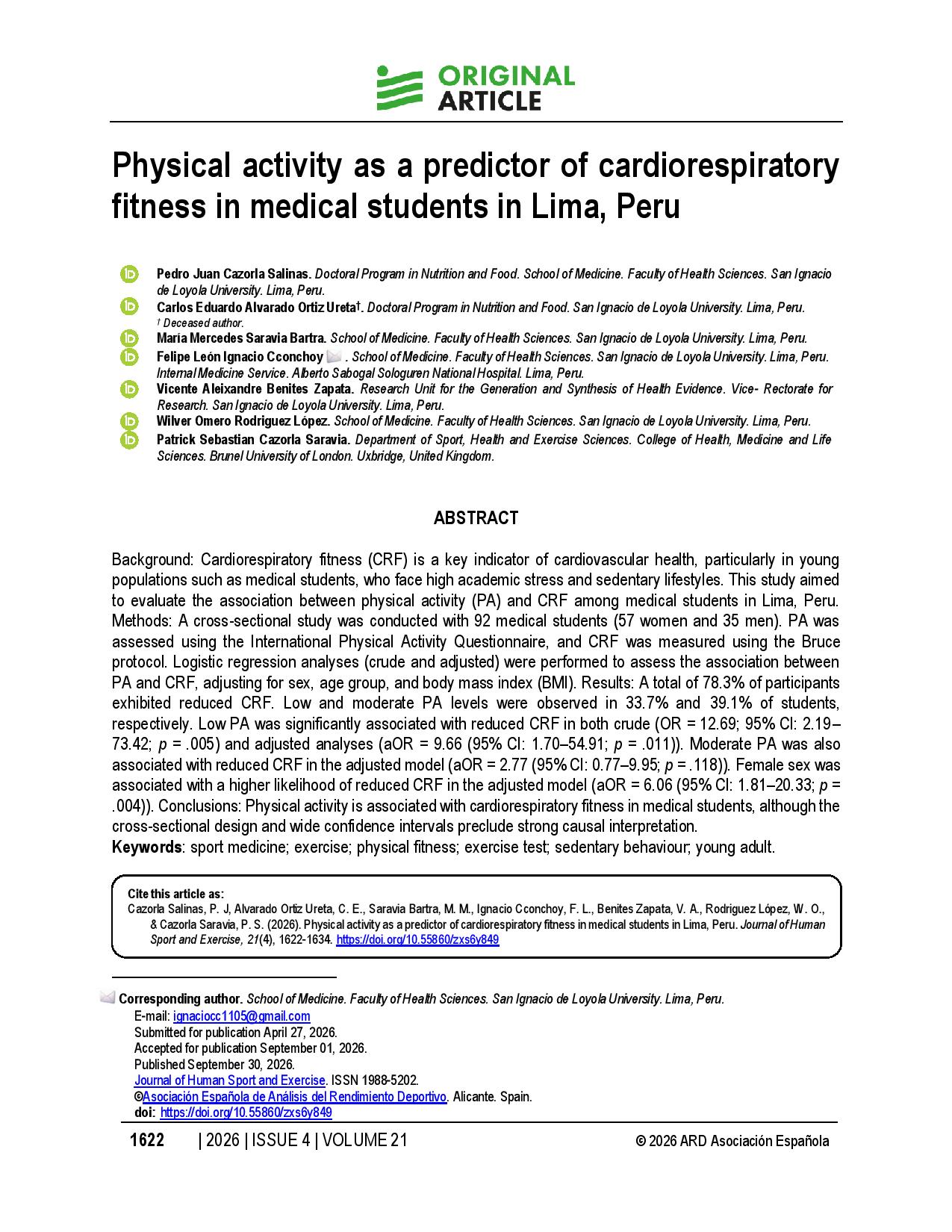
Background: Cardiorespiratory fitness (CRF) is a key indicator of cardiovascular health, particularly in young populations such as medical students, who face high academic stress and sedentary lifestyles. This study aimed to evaluate the association between physical activity (PA) and CRF among medical students in Lima, Peru. Methods: A cross-sectional study was conducted with 92 medical students (57 women and 35 men). PA was assessed using the International Physical Activity Questionnaire, and CRF was measured using the Bruce protocol. Logistic regression analyses (crude and adjusted) were performed to assess the association between PA and CRF, adjusting for sex, age group, and body mass index (BMI). Results: A total of 84.8% of participants exhibited reduced CRF. Low and moderate PA levels were observed in 33.7% and 50.0% of students, respectively. Low PA was significantly associated with reduced CRF in both crude (OR = 12.69; 95% CI: 2.19–73.42; p = .005) and adjusted analyses (aOR = 15.01; 95% CI: 2.13–105.93; p = .007). Moderate PA was also associated with reduced CRF in the adjusted model (aOR = 12.25; 95% CI: 2.30–65.24; p = .003). Female sex was associated with a higher likelihood of reduced CRF in the adjusted model (aOR = 4.38; 95% CI: 1.03–18.69; p = .046). Conclusions: Physical activity is associated with cardiorespiratory fitness in medical students, although the cross-sectional design and wide confidence intervals preclude strong causal interpretation.
Downloads
Article Details
Section

This work is licensed under a Creative Commons Attribution-NonCommercial-ShareAlike 4.0 International License.
Each author warrants that his or her submission to the Work is original and that he or she has full power to enter into this agreement. Neither this Work nor a similar work has been published elsewhere in any language nor shall be submitted for publication elsewhere while under consideration by Journal of Human Sport and Exercise (JHSE). Each author also accepts that the JHSE will not be held legally responsible for any claims of compensation.
Authors wishing to include figures or text passages that have already been published elsewhere are required to obtain permission from the copyright holder(s) and to include evidence that such permission has been granted when submitting their papers. Any material received without such evidence will be assumed to originate from the authors.
Please include at the end of the acknowledgements a declaration that the experiments comply with the current laws of the country in which they were performed. The editors reserve the right to reject manuscripts that do not comply with the abovementioned requirements. The author(s) will be held responsible for false statements or failure to fulfill the above-mentioned requirements.
This title is licensed under a Attribution-NonCommercial-ShareAlike 4.0 International (CC BY-NC-SA 4.0).
You are free to:
Share — copy and redistribute the material in any medium or format.
Adapt — remix, transform, and build upon the material.
The licensor cannot revoke these freedoms as long as you follow the license terms.
Under the following terms:
-
Attribution — You must give appropriate credit, provide a link to the license, and indicate if changes were made. You may do so in any reasonable manner, but not in any way that suggests the licensor endorses you or your use.
-
NonCommercial — You may not use the material for commercial purposes.
-
ShareAlike — If you remix, transform, or build upon the material, you must distribute your contributions under the same license as the original.
- No additional restrictions — You may not apply legal terms or technological measures that legally restrict others from doing anything the license permits.
Notices:
- You do not have to comply with the license for elements of the material in the public domain or where your use is permitted by an applicable exception or limitation.
- No warranties are given. The license may not give you all of the permissions necessary for your intended use. For example, other rights such as publicity, privacy, or moral rights may limit how you use the material.
How to Cite




References
Bhatti, S., Leidi, A., Leake, D., & Li, J.-M. (2020). Studying biological science does not lead to adoption of a healthy lifestyle. Perspectives in Public Health, 140(4), 232–239. https://doi.org/10.1177/1757913919890889 DOI: https://doi.org/10.1177/1757913919890889
Craig, C. L., Marshall, A. L., Sjöström, M., Bauman, A. E., Booth, M. L., Ainsworth, B. E., Pratt, M., Ekelund, U., Yngve, A., Sallis, J. F., & Oja, P. (2003). International physical activity questionnaire: 12-country reliability and validity. Medicine & Science in Sports & Exercise, 35(8), 1381–1395. https://doi.org/10.1249/01.MSS.0000078924.61453.FB DOI: https://doi.org/10.1249/01.MSS.0000078924.61453.FB
DeFina, L. F., Haskell, W. L., Willis, B. L., Barlow, C. E., Finley, C. E., Levine, B. D., & Cooper, K. H. (2015). Physical activity versus cardiorespiratory fitness: Two (partly) distinct components of cardiovascular health? Progress in Cardiovascular Diseases, 57(4), 324–329. https://doi.org/10.1016/j.pcad.2014.09.008 DOI: https://doi.org/10.1016/j.pcad.2014.09.008
Fan, L. M., Collins, A., Geng, L., & Li, J.-M. (2020). Impact of unhealthy lifestyle on cardiorespiratory fitness and heart rate recovery of medical science students. BMC Public Health, 20(1), 1012. https://doi.org/10.1186/s12889-020-09154-x DOI: https://doi.org/10.1186/s12889-020-09154-x
Ferreira Silva, R. M., Mendonça, C. R., Azevedo, V. D., Raoof Memon, A., Noll, P. R. E. S., & Noll, M. (2022). Barriers to high school and university students' physical activity: A systematic review. PLOS ONE, 17(4), e0265913. https://doi.org/10.1371/journal.pone.0265913 DOI: https://doi.org/10.1371/journal.pone.0265913
Foster, C., Jackson, A. S., Pollock, M. L., Taylor, M. M., Hare, J., Sennett, S. M., Rod, J. L., Sarwar, M., & Schmidt, D. H. (1984). Generalized equations for predicting functional capacity from treadmill performance. American Heart Journal, 107(6), 1229–1234. https://doi.org/10.1016/0002-8703(84)90282-5 DOI: https://doi.org/10.1016/0002-8703(84)90282-5
Franklin, B. A., & Jae, S. Y. (2024). Physical activity, cardiorespiratory fitness and atherosclerotic cardiovascular disease: Part 1. Pulse, 12(1), 113–125. https://doi.org/10.1159/000541165 DOI: https://doi.org/10.1159/000541165
Hackney, A. C. (2006). Stress and the neuroendocrine system: The role of exercise as a stressor and modifier of stress. Expert Review of Endocrinology & Metabolism, 1(6), 783–792. https://doi.org/10.1586/17446651.1.6.783 DOI: https://doi.org/10.1586/17446651.1.6.783
Herreros-Irarrázabal, D., González-López, M. F., Nuche-Salgado, R., de Souza-Lima, J., & Mahecha-Matsudo, S. (2024). Physical activity levels and sedentary behaviour according to sex, age, BMI, academic year, and country among medical students in Latin America. BMC Public Health, 24(1), 1699. https://doi.org/10.1186/s12889-024-19133-1 DOI: https://doi.org/10.1186/s12889-024-19133-1
Howard, E. N., Frierson, G. M., Willis, B. L., Haskell, W. L., Powell-Wiley, T. M., & DeFina, L. F. (2013). The impact of race and higher socioeconomic status on cardiorespiratory fitness. Medicine & Science in Sports & Exercise, 45(12), 2286–2291. https://doi.org/10.1249/MSS.0b013e31829c2f4f DOI: https://doi.org/10.1249/MSS.0b013e31829c2f4f
Júdice, P. B., Silva, A. M., Berria, J., Petroski, E. L., Ekelund, U., & Sardinha, L. B. (2017). Sedentary patterns, physical activity and health-related physical fitness in youth: A cross-sectional study. International Journal of Behavioral Nutrition and Physical Activity, 14(1), 25. https://doi.org/10.1186/s12966-017-0481-3 DOI: https://doi.org/10.1186/s12966-017-0481-3
Kaminsky, L. A., Arena, R., Beckie, T. M., Brubaker, P. H., Church, T. S., Forman, D. E., Franklin, B. A., Gulati, M., Lavie, C. J., Myers, J., Patel, M. J., Piña, I. L., Weintraub, W. S., & Williams, M. A. (2013). The importance of cardiorespiratory fitness in the United States: The need for a national registry: A policy statement from the American Heart Association. Circulation, 127(5), 652–662. https://doi.org/10.1161/CIR.0b013e31827ee100 DOI: https://doi.org/10.1161/CIR.0b013e31827ee100
Kaminsky, L. A., Arena, R., & Myers, J. (2015). Reference standards for cardiorespiratory fitness measured with cardiopulmonary exercise testing: Data from the Fitness Registry and the Importance of Exercise National Database (FRIEND). Mayo Clinic Proceedings, 90(11), 1515–1523. https://doi.org/10.1016/j.mayocp.2015.07.026 DOI: https://doi.org/10.1016/j.mayocp.2015.07.026
Kapoor, G., Chauhan, P., Singh, G., Malhotra, N., & Chahal, A. (2022). Physical activity for health and fitness: Past, present and future. Journal of Lifestyle Medicine, 12(1), 9–14. https://doi.org/10.15280/jlm.2022.12.1.9 DOI: https://doi.org/10.15280/jlm.2022.12.1.9
Kodama, S., Saito, K., Tanaka, S., Maki, M., Yachi, Y., Asumi, M., Sugawara, A., Totsuka, K., Shimano, H., Ohashi, Y., Yamada, N., & Sone, H. (2009). Cardiorespiratory fitness as a quantitative predictor of all-cause mortality and cardiovascular events in healthy men and women: A meta-analysis. JAMA, 301(19), 2024–2035. https://doi.org/10.1001/jama.2009.681 DOI: https://doi.org/10.1001/jama.2009.681
Lee, I. M., Shiroma, E. J., Lobelo, F., Puska, P., Blair, S. N., & Katzmarzyk, P. T. (2012). Effect of physical inactivity on major non-communicable diseases worldwide: An analysis of burden of disease and life expectancy. The Lancet, 380(9838), 219–229. https://doi.org/10.1016/S0140-6736(12)61031-9 DOI: https://doi.org/10.1016/S0140-6736(12)61031-9
Lubans, D., Richards, J., Hillman, C., Faulkner, G., Beauchamp, M., Nilsson, M., Kelly, P., Smith, J., Raine, L., & Biddle, S. (2016). Physical activity for cognitive and mental health in youth: A systematic review of mechanisms. Pediatrics, 138(3), e20161642. https://doi.org/10.1542/peds.2016-1642 DOI: https://doi.org/10.1542/peds.2016-1642
Mantilla Toloza, S. C., & Gómez-Conesa, A. (2007). El Cuestionario Internacional de Actividad Física: Un instrumento adecuado en el seguimiento de la actividad física poblacional. Revista Iberoamericana de Fisioterapia y Kinesiología, 10(1), 48–52. https://doi.org/10.1016/S1138-6045(07)73665-1 DOI: https://doi.org/10.1016/S1138-6045(07)73665-1
Mendelson, M., Michallet, A.-S., Tonini, J., Favre-Juvin, A., Guinot, M., Wuyam, B., & Flore, P. (2016). Low cardiorespiratory fitness is partially linked to ventilatory factors in obese adolescents. Pediatric Exercise Science, 28(1), 87–97. https://doi.org/10.1123/pes.2013-0151 DOI: https://doi.org/10.1123/pes.2013-0151
Myers, J., Prakash, M., Froelicher, V., Do, D., Partington, S., & Atwood, J. E. (2002). Exercise capacity and mortality among men referred for exercise testing. The New England Journal of Medicine, 346(11), 793–801. https://doi.org/10.1056/NEJMoa011858 DOI: https://doi.org/10.1056/NEJMoa011858
Nystoriak, M. A., & Bhatnagar, A. (2018). Cardiovascular effects and benefits of exercise. Frontiers in Cardiovascular Medicine, 5, 135. https://doi.org/10.3389/fcvm.2018.00135 DOI: https://doi.org/10.3389/fcvm.2018.00135
Ogawa, T., Spina, R. J., Martin, W. H., 3rd, Kohrt, W. M., Schechtman, K. B., Holloszy, J. O., & Ehsani, A. A. (1992). Effects of aging, sex, and physical training on cardiovascular responses to exercise. Circulation, 86(2), 494–503. https://doi.org/10.1161/01.CIR.86.2.494 DOI: https://doi.org/10.1161/01.CIR.86.2.494
Ombrellaro, K. J., Perumal, N., Zeiher, J., Hoebel, J., Ittermann, T., Ewert, R., Dörr, M., Keil, T., Mensink, G. B. M., & Finger, J. D. (2018). Socioeconomic correlates and determinants of cardiorespiratory fitness in the general adult population: A systematic review and meta-analysis. Sports Medicine - Open, 4(1), 25. https://doi.org/10.1186/s40798-018-0137-0 DOI: https://doi.org/10.1186/s40798-018-0137-0
Pate, R. R., Wang, C.-Y., Dowda, M., Farrell, S. W., & O'Neill, J. R. (2006). Cardiorespiratory fitness levels among US youth 12 to 19 years of age. Archives of Pediatrics & Adolescent Medicine, 160(10), 1005–1012. https://doi.org/10.1001/archpedi.160.10.1005 DOI: https://doi.org/10.1001/archpedi.160.10.1005
Peralta, M., Henriques-Neto, D., Gouveia, É. R., Sardinha, L. B., & Marques, A. (2020). Promoting health-related cardiorespiratory fitness in physical education: A systematic review. PLOS ONE, 15(8), e0237019. https://doi.org/10.1371/journal.pone.0237019 DOI: https://doi.org/10.1371/journal.pone.0237019
Pollock, M. L., Foster, C., Schmidt, D., Hellman, C., Linnerud, A. C., & Ward, A. (1982). Comparative analysis of physiologic responses to three different maximal graded exercise test protocols in healthy women. American Heart Journal, 103(3), 363–373. https://doi.org/10.1016/0002-8703(82)90275-7 DOI: https://doi.org/10.1016/0002-8703(82)90275-7
Prieto-Benavides, D. H., García-Hermoso, A., Izquierdo, M., Alonso-Martínez, A. M., Agostinis-Sobrinho, C., Correa-Bautista, J. E., & Ramírez-Vélez, R. (2019). Cardiorespiratory fitness cut-points are related to body adiposity parameters in Latin American adolescents. Medicina, 55(9), 508. https://doi.org/10.3390/medicina55090508 DOI: https://doi.org/10.3390/medicina55090508
Raghuveer, G., Hartz, J., Lubans, D. R., Takken, T., Wiltz, J. L., Mietus-Snyder, M., Perak, A. M., Baker-Smith, C., Pietris, N., & Edwards, N. M. (2020). Cardiorespiratory fitness in youth: An important marker of health: A scientific statement from the American Heart Association. Circulation, 142(7), e101–e118. https://doi.org/10.1161/CIR.0000000000000866 DOI: https://doi.org/10.1161/CIR.0000000000000866
Ross, R., Blair, S. N., Arena, R., Church, T. S., Després, J. P., Franklin, B. A., Haskell, W. L., Kaminsky, L. A., Levine, B. D., Lavie, C. J., Myers, J., Niebauer, J., Sallis, R., Sawada, S. S., Sui, X., & Wisløff, U. (2016). Importance of assessing cardiorespiratory fitness in clinical practice: A case for fitness as a clinical vital sign: A scientific statement from the American Heart Association. Circulation, 134(24), e653–e699. https://doi.org/10.1161/CIR.0000000000000461 DOI: https://doi.org/10.1161/CIR.0000000000000461
Santos, R., Mota, J., Okely, A. D., Pratt, M., Moreira, C., Coelho-e-Silva, M. J., Vale, S., & Sardinha, L. B. (2014). The independent associations of sedentary behaviour and physical activity on cardiorespiratory fitness. British Journal of Sports Medicine, 48(20), 1508–1512. https://doi.org/10.1136/bjsports-2012-091610 DOI: https://doi.org/10.1136/bjsports-2012-091610
Swift, D. L., Johannsen, N. M., Earnest, C. P., Newton, R. L., McGee, J. E., & Church, T. S. (2017). Cardiorespiratory fitness and exercise training in African Americans. Progress in Cardiovascular Diseases, 60(1), 96–102. https://doi.org/10.1016/j.pcad.2017.06.001 DOI: https://doi.org/10.1016/j.pcad.2017.06.001
Tatius, B., Hajar, N., Tursinawati, Y., Romadhoni, R., Baihaqi, M. H., Muhammad, K., Akmal, M. I., & Ja'far, I. M. (2024). Factors affecting cardiorespiratory fitness among medical students: A cross-sectional study. Universal Journal of Public Health, 12(5), 820–827. https://doi.org/10.13189/ujph.2024.120504 DOI: https://doi.org/10.13189/ujph.2024.120504
Tomkinson, G. R., Lang, J. J., & Tremblay, M. S. (2019). Temporal trends in the cardiorespiratory fitness of children and adolescents representing 19 high-income and upper middle-income countries between 1981 and 2014. British Journal of Sports Medicine, 53(8), 478–486. https://doi.org/10.1136/bjsports-2017-097982 DOI: https://doi.org/10.1136/bjsports-2017-097982
von Elm, E., Altman, D. G., Egger, M., Pocock, S. J., Gøtzsche, P. C., & Vandenbroucke, J. P. (2007). The Strengthening the Reporting of Observational Studies in Epidemiology (STROBE) statement: Guidelines for reporting observational studies. The Lancet, 370(9596), 1453–1457. https://doi.org/10.1016/S0140-6736(07)61602-X DOI: https://doi.org/10.1016/S0140-6736(07)61602-X
World Health Organization. (2000). Obesity: Preventing and managing the global epidemic: Report of a WHO consultation (WHO Technical Report Series No. 894).
World Health Organization. (2018). Global action plan on physical activity 2018–2030: More active people for a healthier world. World Health Organization.
Zyriax, B.-C., & Windler, E. (2023). Lifestyle changes to prevent cardio- and cerebrovascular disease at midlife: A systematic review. Maturitas, 167, 60–65. https://doi.org/10.1016/j.maturitas.2022.09.003 DOI: https://doi.org/10.1016/j.maturitas.2022.09.003