Smartphone overuse Effect of rehabilitation program on neck ROM, trapezius, and sternocleidomastoids muscle effort in collegiate asymptomatic individuals
Article Sidebar
Main Article Content
Abstract
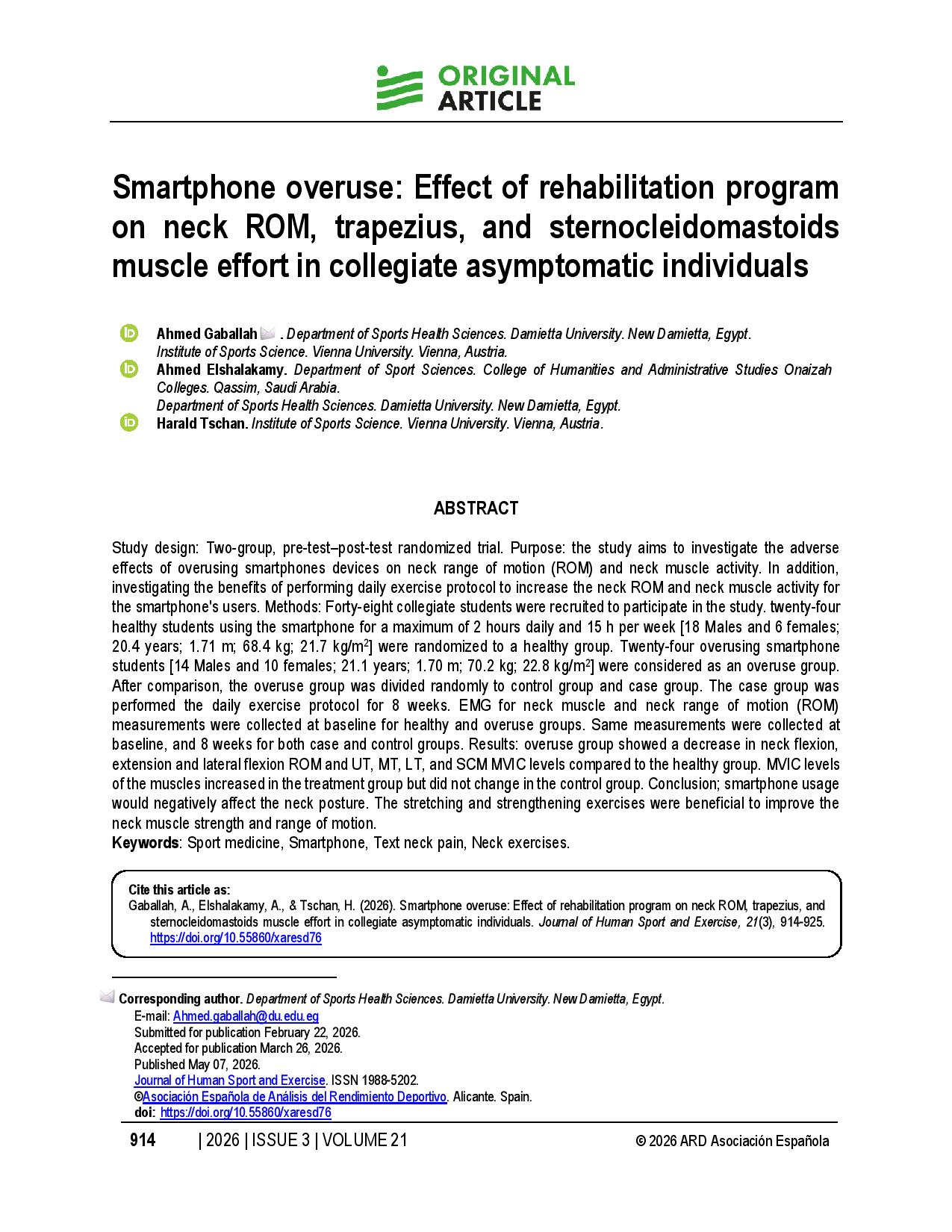
Study design: Two-group, pre-test–post-test randomized trial. Purpose: the study aims to investigate the adverse effects of overusing smartphones devices on neck range of motion (ROM) and neck muscle activity. In addition, investigating the benefits of performing daily exercise protocol to increase the neck ROM and neck muscle activity for the smartphone's users. Methods: Forty-eight collegiate students were recruited to participate in the study. twenty-four healthy students using the smartphone for a maximum of 2 hours daily and 15 h per week [18 Males and 6 females; 20.4 years; 1.71 m; 68.4 kg; 21.7 kg/m2] were randomized to a healthy group. Twenty-four overusing smartphone students [14 Males and 10 females; 21.1 years; 1.70 m; 70.2 kg; 22.8 kg/m2] were considered as an overuse group. After comparison, the overuse group was divided randomly to control group and case group. The case group was performed the daily exercise protocol for 8 weeks. EMG for neck muscle and neck range of motion (ROM) measurements were collected at baseline for healthy and overuse groups. Same measurements were collected at baseline, and 8 weeks for both case and control groups. Results: overuse group showed a decrease in neck flexion, extension and lateral flexion ROM and UT, MT, LT, and SCM MVIC levels compared to the healthy group. MVIC levels of the muscles increased in the treatment group but did not change in the control group. Conclusion; smartphone usage would negatively affect the neck posture. The stretching and strengthening exercises were beneficial to improve the neck muscle strength and range of motion.
Downloads
Article Details
Section

This work is licensed under a Creative Commons Attribution-NonCommercial-ShareAlike 4.0 International License.
Each author warrants that his or her submission to the Work is original and that he or she has full power to enter into this agreement. Neither this Work nor a similar work has been published elsewhere in any language nor shall be submitted for publication elsewhere while under consideration by Journal of Human Sport and Exercise (JHSE). Each author also accepts that the JHSE will not be held legally responsible for any claims of compensation.
Authors wishing to include figures or text passages that have already been published elsewhere are required to obtain permission from the copyright holder(s) and to include evidence that such permission has been granted when submitting their papers. Any material received without such evidence will be assumed to originate from the authors.
Please include at the end of the acknowledgements a declaration that the experiments comply with the current laws of the country in which they were performed. The editors reserve the right to reject manuscripts that do not comply with the abovementioned requirements. The author(s) will be held responsible for false statements or failure to fulfill the above-mentioned requirements.
This title is licensed under a Attribution-NonCommercial-ShareAlike 4.0 International (CC BY-NC-SA 4.0).
You are free to:
Share — copy and redistribute the material in any medium or format.
Adapt — remix, transform, and build upon the material.
The licensor cannot revoke these freedoms as long as you follow the license terms.
Under the following terms:
-
Attribution — You must give appropriate credit, provide a link to the license, and indicate if changes were made. You may do so in any reasonable manner, but not in any way that suggests the licensor endorses you or your use.
-
NonCommercial — You may not use the material for commercial purposes.
-
ShareAlike — If you remix, transform, or build upon the material, you must distribute your contributions under the same license as the original.
- No additional restrictions — You may not apply legal terms or technological measures that legally restrict others from doing anything the license permits.
Notices:
- You do not have to comply with the license for elements of the material in the public domain or where your use is permitted by an applicable exception or limitation.
- No warranties are given. The license may not give you all of the permissions necessary for your intended use. For example, other rights such as publicity, privacy, or moral rights may limit how you use the material.
How to Cite




References
Andersen L, Mortensen C, Poulsen O, Bjørnlund I, Zebis M.(2010). Muscle Activation and Perceived Loading During Rehabilitation Exercises: Comparison of Dumbbells and Elastic Resistance. Physical Therapy, 90(4): 538-549. https://doi.org/10.2522/ptj.20090167
Ayhan H, Tastan S, Iyig ̈un E, Ozt ̈urk E, Yildiz R, G ̈org ̈ul ̈u S.(2016) The Effectiveness of Neck Stretching Exercises Following Total Thyroidectomy on Reducing Neck Pain and Disability: A Randomized Controlled Trial. Worldviews on Evidence-Based Nursing, 13(3): 1-8. https://doi.org/10.1111/wvn.12136
Balakrishnan, R., Chinnavan, E., Feii, T. (2016). An extensive usage of hand held devices will lead to musculoskeletal disorder of upper extremity among student in AMU: a survey method. Int. J. Phys. Educ. Sports Health 3 (2), 368e372.
Berolo S, Wells R, Amick B. (2011). Musculoskeletal symptoms among mobile hand-held device users and their relationship to device use: A preliminary study in a Canadian university population, Applied Ergonomic, 42(2):371-8. https://doi.org/10.1016/j.apergo.2010.08.010
Bobos P, Papanikolaou T, Koutsojannis C, MacDermid J, Billis E.(2016). Is deep cervical neck flexors' training more effective than general neck exercises or advice in patients with chronic neck pain? A prospective randomized controlled trial. Manual Therapy, 25: e145-e146. https://doi.org/10.1016/j.math.2016.05.280
Caputo GM, Di Bari M, Orellana JN.(2017). Group-based exercise at workplace: short-term effects of neck and shoulder resistance training in video display unit workers with work-related chronic neck pain-a pilot randomized trial. Clinical Rheumatology, 2:1-9. https://doi.org/10.1007/s10067-017-3629-2
Cuéllar JM, Lanman TH. Text neck.(2017). an epidemic of the modern era of cell phones? The Spine Journal, 1;17(6):901-20. https://doi.org/10.1016/j.spinee.2017.03.009
Damasceno GM, Ferreira AS, Nogueira LA, Reis FJ, Andrade IC, Meziat-Filho N.(2018). Text neck and neck pain in 18-21-year-old young adults. European Spine Journal, 1;27(6):1249-54. https://doi.org/10.1007/s00586-017-5444-5
Dvir, Z and Prushansky, T. (2008). Cervical muscles strength testing: Methods and clinical implications, J. of Manipulative and Physiological Therapeutics Spine 15; 25(12), pp.1548-54. https://doi.org/10.1016/j.jmpt.2008.08.008
Falla D, Lindstrøm R, Rechter L, Boudreau S, Petzke F.(2013). Effectiveness of an 8-week exercise programme on pain and specificity of neck muscle activity in patients with chronic neck pain: A randomized controlled study, European Journal of Pain, 17(10): 1517-1528. https://doi.org/10.1002/j.1532-2149.2013.00321.x
Gaballah A , Zeyada M, Elgeidi A, Bressel E.(2017). Six-week physical rehabilitation protocol for anterior shoulder dislocation in athletes, J Exerc Rehabil, 30;13(3):353-358. https://doi.org/10.12965/jer.1734976.488
Ghazwan A, Forrest SM, Holt CA, Whatling GM.(2017). Can activities of daily living contribute to EMG normalization for gait analysis? PloS one, 3;12(4): e0174670. https://doi.org/10.1371/journal.pone.0174670
Gilchrist I, Moglo K, Storr M, Pelland L. (2016). Effects of head flexion posture on the multidirectional static force capacity of the neck, Clinical Biomechanics, Aug 31; 37:44-52. https://doi.org/10.1371/journal.pone.0174670
Gold, J. E., B. Driban J, V. R. Yingling, and E. Komaroff. (2012). Characterization of Posture and Comfort in Laptop Users in Non-desk Settings, Applied Ergonomics 43 (2): 392- 399. https://doi.org/10.1016/j.apergo.2011.06.014
Guan X, Fan G, Chen Z, Zeng Y, Zhang H, Hu A, Gu G, Wu X, Gu X, He S.(2016). Gender difference in mobile phone use and the impact of digital device exposure on neck posture. Ergonomics, 1;59(11):1453-61. https://doi.org/10.1080/00140139.2016.1147614
Gustafsson E, Thomée S, Grimby-Ekman A, Hagberg M.(2017). Texting on mobile phones and musculoskeletal disorders in young adults: a five-year cohort study. Applied ergonomics, 31; 58:208-14. 6. https://doi.org/10.1016/j.apergo.2016.06.012
Gustafsson, E., P. W. Johnson, A. Lindega ˚rd, and M. Hagberg. (2011). Technique, Muscle Activity and Kinematic Differences in Young Adults Texting on Mobile Phones, Ergonomics 54 (5): 477-487. https://doi.org/10.1080/00140139.2011.568634
Harms-Ringdahl K, Ekholm J, Schüldt K, Nemeth G, Arborelius .(1986). Load moments and myoelectric activity when the cervical spine is held in full flexion and extension. Ergonomics 29: 1539-1552. https://doi.org/10.1080/00140138608967267
Jull G, Sterling M, Kenardy J, Beller E .(2007). Does the presence of sensory hypersensitivity influence outcomes of physical rehabilitation for chronic whiplash?--A preliminary RCT, Pain, 129(2): 28-34. https://doi.org/10.1016/j.pain.2006.09.030
Kietrys DM, Gerg MJ, Dropkin J, Gold JE.(2015). Mobile input device type, texting style and screen size influence upper extremity and trapezius muscle activity, and cervical posture while texting,Applied ergonomics, 1;50:98-104. https://doi.org/10.1016/j.apergo.2015.03.003
Kim H, Kim J. (2015). The relationship between smartphone use and subjective musculoskeletal symptoms and university students, J. Phys. Ther. Sci, 27(3): 575-9. https://doi.org/10.1589/jpts.27.575
Kim H.(2013). Exercise rehabilitation for smartphone addiction. Journal of Exercise Rehabilitation, 9(6): 500-5. https://doi.org/10.12965/jer.130080
Kim HY, Yeun YR, Kim SJ.(2016). Preventive effects of stretching and stabilization exercises on muscle fatigue in mobile phone users, J Phys Ther Sci, 28(9):2529-2532. https://doi.org/10.1589/jpts.28.2529
Kim S, Koo S.(2016). Effect of duration of smartphone use on muscle fatigue and pain caused by forward head posture in adults, The Journal of Physical Therapy Science, 28(6): 1669-1672. https://doi.org/10.1589/jpts.28.1669
Kim Y, Kang M, Kim W. (2013). Influence of the duration of smartphone usage on flexion angles of the cervical and lumbar spine and on reposition error in the cervical spine, Physical Therapy Korea, 20: 10-17. https://doi.org/10.12674/ptk.2013.20.1.010
Kim, M. S.(2015). Influence of neck pain on cervical movement in the sagittal plane during smartphone use, Journal of Physical Therapy Science , 27 (1): 15-17. https://doi.org/10.1589/jpts.27.15
Larsson B, Søgaard K, Rosendal L.(2007). Work related neck-shoulder pain: a review on magnitude, risk factors, biochemical characteristics, clinical picture and preventive interventions, Best Pract Res Clin Rheumatol , 21(3):447-463. https://doi.org/10.1016/j.berh.2007.02.015
Lee HJ.(2016). Neck Pain and Functioning in Daily Activities Associated with Smartphone Usage. Korian journal of Physio Therapy, 28(3): 183-8. https://doi.org/10.18857/jkpt.2016.28.3.183
Lee K, Kim W. (2016). Effect of thoracic manipulation and deep craniocervical flexor training on pain, mobility, strength, and disability of the neck of patients with chronic nonspecific neck pain: a randomized clinical trial, The Journal of Physical Therapy Science, 28(1): 175-180. https://doi.org/10.1589/jpts.28.175
Lee S, Kang H, Shin G.(2015). Head flexion angle while using a smartphone. Ergonomics, 1;58(2):220-6. https://doi.org/10.1080/00140139.2014.967311
Lepp A, Barkley JE, Sanders G, ReboldM, Gates P.(2013). The relationship between cell phone use, physical and sedentary activity, and cardiorespiratory fitness in a sample of US college students. Int, J. Behav. Nutr. Phys. Activity, 10:79. https://doi.org/10.1186/1479-5868-10-79
Lin IM, Peper E.(2009). Psychophysiological patterns during cell phone text messaging: A preliminary study, Appl Psychophysiology and Biofeedback 34: 53-57. https://doi.org/10.1007/s10484-009-9078-1
Ludvigsson M, Peterson G, O'Leary S, Dedering A, Peolsson A.(2015). The effect of neck specific exercise with, or without a behavioral approach, on pain, disability, and self-efficacy in chronic whiplash-associated disorders: a randomized clinical trial. The Clinical Journal of Pain, 31(4): 294-303. https://doi.org/10.1097/AJP.0000000000000123
Ning X, Huang Y, Hu B, Nimbarte A.(2015). Neck kinematics and muscle activity during mobile device operations. International Journal of Industrial Ergonomics, 48:10-15. https://doi.org/10.1016/j.ergon.2015.03.003
Park JH Ms, Kang SY PhD, Lee SG PhD, Jeon HS PhD. (2017). The effects of smart phone gaming duration on muscle activation and spinal posture: Pilot study. Physiother Theory Pract,33(8):661-669. https://doi.org/10.1080/09593985.2017.1328716
Park JH, Kang SY, Jeon HS. (2013). The effect of using smart- phones on neck and shoulder muscle activities and fatigue, Physical Therapy Korea 20: 19-26. https://doi.org/10.12674/ptk.2013.20.3.019
Rezasoltani A, Ahmadipoor A, Khademi KK, Javanshir K.(2012). The sign of unilateral neck semispinalis capitis muscle atrophy in patients with chronic non-specific neck pain, J Back Musculoskelet Rehabil, 25(1): 67-72. https://doi.org/10.3233/BMR-2012-0303
Ris I, Søgaard K, Gram B, Agerbo K, Boyle E, Juul-Kristensen B.(2016). Does a combination of physical training, specific exercises and pain education improve health-related quality of life in patients with chronic neck pain? A randomised control trial with a 4-month follow up, Manual Therapy, 26: 132-140. https://doi.org/10.1016/j.math.2016.08.004
Rudolfsson T, Bjorklund M, Djupsjobacka M.(2012). Range of motion in the upper and lower cervical spine in people with chronic neck pain, Man Ther, 17(1):53-9. https://doi.org/10.1016/j.math.2011.08.007
Schabrun SM, van den Hoorn W, Moorcroft A, Greenland C, Hodges PW.(2014). Texting and walking: strategies for postural control and implications for safety, PLoS One, 22:9(1): e84312. https://doi.org/10.1371/journal.pone.0084312
Shan Z, Deng G, Li J, Li Y, Zhang Y, Zhao Q.(2013). Correlational analysis of neck/shoulder pain and low back pain with the use of digital products, physical activity and psychological status among adolescents in Shanghai, Plos one,11;8(10):e78109. https://doi.org/10.1371/journal.pone.0078109
Shin WS, Park SJ.(1997). Basic Fitness Q&A for a coach, Seoul: Hong Kyeong Publishers.
Skierkowski D, Wood RM.(2012). To text or not to text? The importance of text messaging among college-aged youth, Computers in Human Behavior, 1;28(2):744-56. https://doi.org/10.1016/j.chb.2011.11.023
Toh SH, Coenen P, Howie EK, Straker LM.(2017). The associations of mobile touch screen device use with musculoskeletal symptoms and exposures: A systematic review, PloS one, 7;12(8): e0181220.11. https://doi.org/10.1371/journal.pone.0181220
Tousignant M, de Bellefeuille L, O'donoughue S, Grahovac S.(2000). Criterion validity of the cervical range of motion (CROM) goniometer for cervical flexion and extension. Spine, 1;25(3):324-30. https://doi.org/10.1097/00007632-200002010-00011
Williamson E, Williams M, Gates S, Lamb S.(2015). Risk factors for chronic disability in a cohort of patients with acute whiplash associated disorders seeking physiotherapy treatment for persisting symptoms, Physiotherapy, 101 (1): 134-143. https://doi.org/10.1016/j.physio.2014.04.004
Xie Y, Szeto G, Dai J, Madeleine P.(2016). A comparison of muscle activity in using touchscreen smartphone among young people with and without chronic neck-shoulder pain. Ergonomics, 591: 61-72. https://doi.org/10.1080/00140139.2015.1056237
Xie Y, Szeto G, Dai J.(2017). Prevalence and risk factors associated with musculoskeletal complaints among users of mobile handheld devices: A systematic review. Applied ergonomics, 1; 59:132-42. https://doi.org/10.1016/j.apergo.2016.08.020
Xie YF, Szeto G, Madeleine P, Tsang S.(2018). Spinal kinematics during smartphone texting-A comparison between young adults with and without chronic neck-shoulder pain. Applied ergonomics, 30; 68:160-8. https://doi.org/10.1016/j.apergo.2017.10.018