Notational analysis of the Croatian first football league Technical, tactical and performance indicators during the 2025/2026 season
Article Sidebar
Main Article Content
Abstract
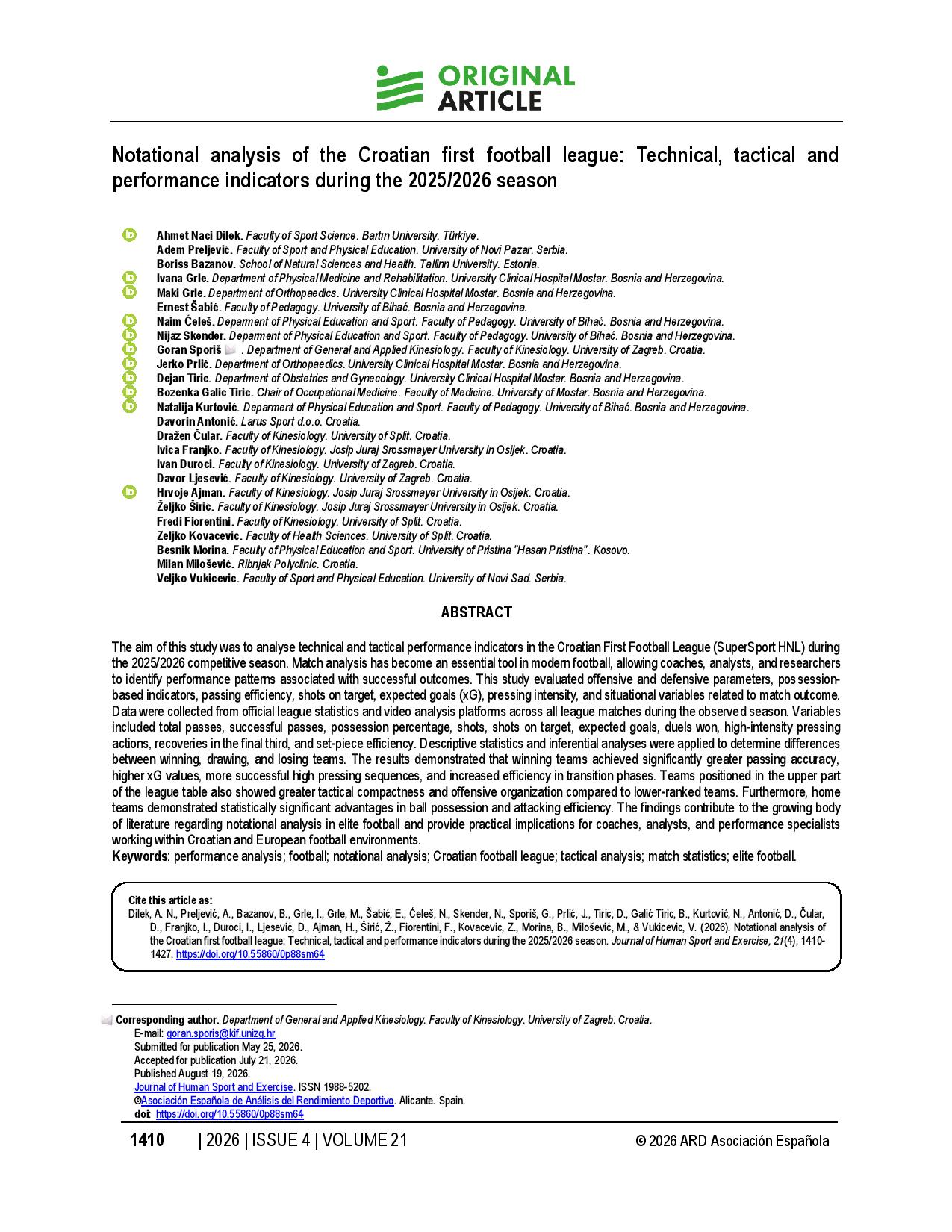
The aim of this study was to analyse technical and tactical performance indicators in the Croatian First Football League (SuperSport HNL) during the 2025/2026 competitive season. Match analysis has become an essential tool in modern football, allowing coaches, analysts, and researchers to identify performance patterns associated with successful outcomes. This study evaluated offensive and defensive parameters, possession-based indicators, passing efficiency, shots on target, expected goals (xG), pressing intensity, and situational variables related to match outcome. Data were collected from official league statistics and video analysis platforms across all league matches during the observed season. Variables included total passes, successful passes, possession percentage, shots, shots on target, expected goals, duels won, high-intensity pressing actions, recoveries in the final third, and set-piece efficiency. Descriptive statistics and inferential analyses were applied to determine differences between winning, drawing, and losing teams. The results demonstrated that winning teams achieved significantly greater passing accuracy, higher xG values, more successful high pressing sequences, and increased efficiency in transition phases. Teams positioned in the upper part of the league table also showed greater tactical compactness and offensive organization compared to lower-ranked teams. Furthermore, home teams demonstrated statistically significant advantages in ball possession and attacking efficiency. The findings contribute to the growing body of literature regarding notational analysis in elite football and provide practical implications for coaches, analysts, and performance specialists working within Croatian and European football environments.
Downloads
Article Details
Section

This work is licensed under a Creative Commons Attribution-NonCommercial-ShareAlike 4.0 International License.
Each author warrants that his or her submission to the Work is original and that he or she has full power to enter into this agreement. Neither this Work nor a similar work has been published elsewhere in any language nor shall be submitted for publication elsewhere while under consideration by Journal of Human Sport and Exercise (JHSE). Each author also accepts that the JHSE will not be held legally responsible for any claims of compensation.
Authors wishing to include figures or text passages that have already been published elsewhere are required to obtain permission from the copyright holder(s) and to include evidence that such permission has been granted when submitting their papers. Any material received without such evidence will be assumed to originate from the authors.
Please include at the end of the acknowledgements a declaration that the experiments comply with the current laws of the country in which they were performed. The editors reserve the right to reject manuscripts that do not comply with the abovementioned requirements. The author(s) will be held responsible for false statements or failure to fulfill the above-mentioned requirements.
This title is licensed under a Attribution-NonCommercial-ShareAlike 4.0 International (CC BY-NC-SA 4.0).
You are free to:
Share — copy and redistribute the material in any medium or format.
Adapt — remix, transform, and build upon the material.
The licensor cannot revoke these freedoms as long as you follow the license terms.
Under the following terms:
-
Attribution — You must give appropriate credit, provide a link to the license, and indicate if changes were made. You may do so in any reasonable manner, but not in any way that suggests the licensor endorses you or your use.
-
NonCommercial — You may not use the material for commercial purposes.
-
ShareAlike — If you remix, transform, or build upon the material, you must distribute your contributions under the same license as the original.
- No additional restrictions — You may not apply legal terms or technological measures that legally restrict others from doing anything the license permits.
Notices:
- You do not have to comply with the license for elements of the material in the public domain or where your use is permitted by an applicable exception or limitation.
- No warranties are given. The license may not give you all of the permissions necessary for your intended use. For example, other rights such as publicity, privacy, or moral rights may limit how you use the material.
How to Cite




References
Almeida, C. H., Ferreira, A. P., & Volossovitch, A. (2024). Technical and tactical determinants of football performance in elite competitions. International Journal of Performance Analysis in Sport, 24(2), 115–129.
Bradley, P. S., & Ade, J. D. (2024). High-intensity tactical behaviour in elite football competitions. Journal of Sports Sciences, 42(4), 411–425.
Castellano, J., Alvarez-Pastor, D., & Bradley, P. S. (2024). Contextual variables and tactical performance in professional football. International Journal of Sports Science & Coaching, 19(1), 66–81.
Clemente, F. M., Sarmento, H., & Rabbani, A. (2025). Pressing structures and tactical efficiency in elite football. Sports Medicine, 55(1), 73–91.
Dellal, A., Lago-Peñas, C., & Rey, E. (2024). Collective tactical synchronization in professional football. Biology of Sport, 41(2), 215–228.
Fernandez-Navarro, J., Fradua, L., & Zubillaga, A. (2024). Positional data and tactical dynamics in elite football. Frontiers in Sports and Active Living, 6, 1–14.
Goes, F. R., Kempe, M., & Meerhoff, L. A. (2025). Transition efficiency and match success in elite football. European Journal of Sport Science, 25(3), 341–355.
Hughes, M. D., & Bartlett, R. M. (2002). The use of performance indicators in performance analysis. Journal of Sports Sciences, 20(10), 739–754. https://doi.org/10.1080/026404102320675602 DOI: https://doi.org/10.1080/026404102320675602
Hughes, M., & Franks, I. M. (2005). Analysis of passing sequences, shots, and goals in soccer. Journal of Sports Sciences, 23(5), 509–514. https://doi.org/10.1080/02640410410001716779 DOI: https://doi.org/10.1080/02640410410001716779
Jovanović, M., Sporiš, G., Omrčen, D., & Fiorentini, F. (2011). Effects of speed, agility, quickness training method on power performance in elite soccer players. Journal of Strength and Conditioning Research, 25(5), 1285–1292. https://doi.org/10.1519/JSC.0b013e3181d67c65 DOI: https://doi.org/10.1519/JSC.0b013e3181d67c65
Lago-Peñas, C., Gómez-Ruano, M., & Yang, G. (2024). Home advantage and contextual effects in elite football performance. Journal of Human Kinetics, 91, 55–69.
Liu, H., Gómez, M. A., & Gonçalves, B. (2025). Expected goals and predictive analytics in elite football. PLOS ONE, 20(1), Article e0312245.
Memmert, D., & Rein, R. (2024). Spatial control and defensive compactness in football. Frontiers in Psychology, 15, 1–13.
Mihačić, V., Sporiš, G., Jukić, I., Milanović, D., Ivanković, B., & Komes, Z. (2003). Strength and conditioning training in football [Unpublished manuscript].
Milanović, Z., Pantelić, S., Čović, N., Sporiš, G., & Krustrup, P. (2015). Is recreational soccer effective for improving physical fitness? A systematic review and meta-analysis. Sports Medicine, 45(9), 1339–1353. https://doi.org/10.1007/s40279-015-0361-4 DOI: https://doi.org/10.1007/s40279-015-0361-4
Milanović, Z., Sporiš, G., Trajković, N., James, N., & Šamija, K. (2013). Effects of a 12-week SAQ training programme on agility with and without the ball among young soccer players. Journal of Sports Science and Medicine, 12(1), 97–103.
Sarmento, H., Clemente, F. M., & Afonso, J. (2024). Offensive transition patterns in elite football. International Journal of Environmental Research and Public Health, 21(4), 1882–1897.
Sporiš, G. (2003). The analysis of the football game in the function of planning and programming physical preparedness [Unpublished manuscript]. Faculty of Kinesiology, University of Zagreb.
Sporiš, G. (2026). Notational analysis in football: A review paper [Conference presentation]. HAIPER Conference, Split, Croatia.
Sporiš, G., & Tomić, V. (2004). Applying some of the content of kinesiology in the prevention of back muscle injury in football [Unpublished manuscript].
Sporiš, G., Čanaki, M., & Barišić, V. (2007). Morphological differences of elite Croatian female soccer players according to the team position. Hrvatski Športskomedicinski Vjesnik, 22(2), 91–96.
Sporiš, G., Jukić, I., Milanović, L., & Vučetić, V. (2010). Reliability and factorial validity of agility tests for soccer players. Journal of Strength and Conditioning Research, 24(3), 679–686. https://doi.org/10.1519/JSC.0b013e3181c4d324 DOI: https://doi.org/10.1519/JSC.0b013e3181c4d324
Sporiš, G., Jukić, I., Ostojić, S. M., & Milanović, D. (2009). Fitness profiling in soccer: Physical and physiologic characteristics of elite players. Journal of Strength and Conditioning Research, 23(7), 1947–1953. https://doi.org/10.1519/JSC.0b013e3181b3e141 DOI: https://doi.org/10.1519/JSC.0b013e3181b3e141