Cardiorespiratory fitness as an integrative correlate of mental health in physically inactive university students A cross-sectional study
Article Sidebar
Main Article Content
Abstract
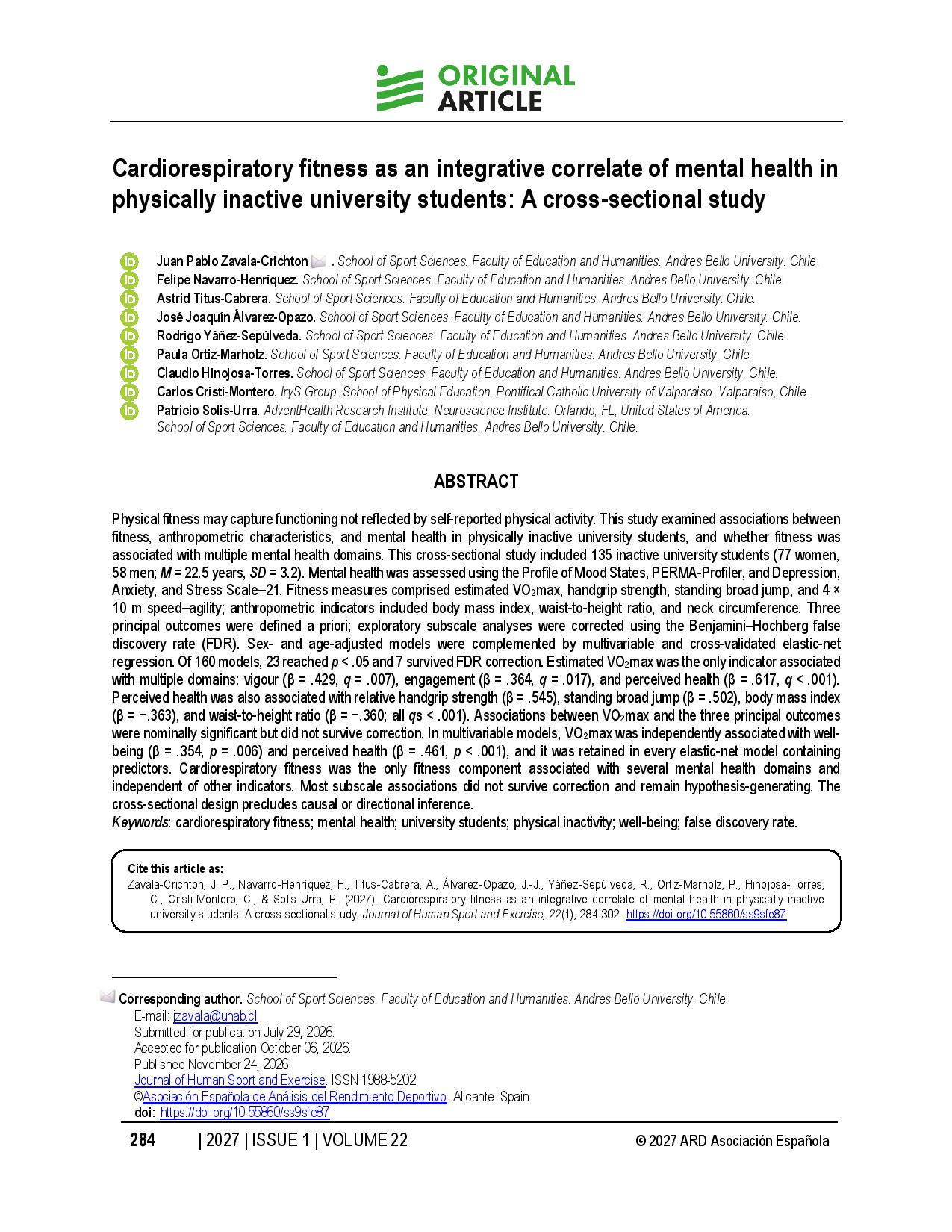
Physical fitness may capture functioning not reflected by self-reported physical activity. This study examined associations between fitness, anthropometric characteristics, and mental health in physically inactive university students, and whether fitness was associated with multiple mental health domains. This cross-sectional study included 135 inactive university students (77 women, 58 men; M = 22.5 years, SD = 3.2). Mental health was assessed using the Profile of Mood States, PERMA-Profiler, and Depression, Anxiety, and Stress Scale–21. Fitness measures comprised estimated VO2max, handgrip strength, standing broad jump, and 4 × 10 m speed–agility; anthropometric indicators included body mass index, waist-to-height ratio, and neck circumference. Three principal outcomes were defined a priori; exploratory subscale analyses were corrected using the Benjamini–Hochberg false discovery rate (FDR). Sex- and age-adjusted models were complemented by multivariable and cross-validated elastic-net regression. Of 160 models, 23 reached p < .05 and 7 survived FDR correction. Estimated VO2max was the only indicator associated with multiple domains: vigour (β = .429, q = .007), engagement (β = .364, q = .017), and perceived health (β = .617, q < .001). Perceived health was also associated with relative handgrip strength (β = .545), standing broad jump (β = .502), body mass index (β = −.363), and waist-to-height ratio (β = −.360; all qs < .001). Associations between VO2max and the three principal outcomes were nominally significant but did not survive correction. In multivariable models, VO2max was independently associated with well-being (β = .354, p = .006) and perceived health (β = .461, p < .001), and it was retained in every elastic-net model containing predictors. Cardiorespiratory fitness was the only fitness component associated with several mental health domains and independent of other indicators. Most subscale associations did not survive correction and remain hypothesis-generating. The cross-sectional design precludes causal or directional inference.
Downloads
Article Details
Section

This work is licensed under a Creative Commons Attribution-NonCommercial-ShareAlike 4.0 International License.
Each author warrants that his or her submission to the Work is original and that he or she has full power to enter into this agreement. Neither this Work nor a similar work has been published elsewhere in any language nor shall be submitted for publication elsewhere while under consideration by Journal of Human Sport and Exercise (JHSE). Each author also accepts that the JHSE will not be held legally responsible for any claims of compensation.
Authors wishing to include figures or text passages that have already been published elsewhere are required to obtain permission from the copyright holder(s) and to include evidence that such permission has been granted when submitting their papers. Any material received without such evidence will be assumed to originate from the authors.
Please include at the end of the acknowledgements a declaration that the experiments comply with the current laws of the country in which they were performed. The editors reserve the right to reject manuscripts that do not comply with the abovementioned requirements. The author(s) will be held responsible for false statements or failure to fulfill the above-mentioned requirements.
This title is licensed under a Attribution-NonCommercial-ShareAlike 4.0 International (CC BY-NC-SA 4.0).
You are free to:
Share — copy and redistribute the material in any medium or format.
Adapt — remix, transform, and build upon the material.
The licensor cannot revoke these freedoms as long as you follow the license terms.
Under the following terms:
-
Attribution — You must give appropriate credit, provide a link to the license, and indicate if changes were made. You may do so in any reasonable manner, but not in any way that suggests the licensor endorses you or your use.
-
NonCommercial — You may not use the material for commercial purposes.
-
ShareAlike — If you remix, transform, or build upon the material, you must distribute your contributions under the same license as the original.
- No additional restrictions — You may not apply legal terms or technological measures that legally restrict others from doing anything the license permits.
Notices:
- You do not have to comply with the license for elements of the material in the public domain or where your use is permitted by an applicable exception or limitation.
- No warranties are given. The license may not give you all of the permissions necessary for your intended use. For example, other rights such as publicity, privacy, or moral rights may limit how you use the material.
How to Cite




References
Alfaro-González, S., Garrido-Miguel, M., Pascual-Morena, C., Pozuelo-Carrascosa, D. P., Fernández-Rodríguez, R., Martínez-Hortelano, J. A., Mesas, A. E., & Martínez-Vizcaíno, V. (2025). The association between adherence to the Mediterranean diet and depression and anxiety symptoms in university students. Nutrients, 17(2), 346. https://doi.org/10.3390/nu17020346
Alghawrien, D. A., Al-Hussami, M., & Ayaad, O. (2022). The impact of obesity on self-esteem and academic achievement among university students. International Journal of Adolescent Medicine and Health, 34(3), 20190137. https://doi.org/10.1515/ijamh-2019-0137
American College of Sports Medicine. (2021). ACSM's guidelines for exercise testing and prescription (11th ed.). Wolters Kluwer.
Antúnez, Z., & Vinet, E. V. (2012). Depression Anxiety Stress Scales (DASS-21): Validation of the abbreviated version in Chilean university students. Terapia Psicológica, 30(3), 49-55. https://doi.org/10.4067/S0718-48082012000300005
Arce Fernández, C., Andrade Fernández, E. M., & Seoane Pesqueira, G. (2000). Problemas semánticos en la adaptación del POMS al castellano. Psicothema, 12(2), 199-206.
Auerbach, R. P., Mortier, P., Bruffaerts, R., Alonso, J., Benjet, C., Cuijpers, P., … Kessler, R. C. (2018). WHO World Mental Health Surveys International College Student Project: Prevalence and distribution of mental disorders. Journal of Abnormal Psychology, 127(7), 623-638. https://doi.org/10.1037/abn0000362
Åvitsland, A., Leibinger, E., Haugen, T., Lerum, Ø., Solberg, R. B., Kolle, E., & Dyrstad, S. M. (2020). The association between physical fitness and mental health in Norwegian adolescents. BMC Public Health, 20, 776. https://doi.org/10.1186/s12889-020-08936-7
Bayram, N., & Bilgel, N. (2008). The prevalence and socio-demographic correlations of depression, anxiety and stress among a group of university students. Social Psychiatry and Psychiatric Epidemiology, 43(8), 667-672. https://doi.org/10.1007/s00127-008-0345-x
Benjamini, Y., & Hochberg, Y. (1995). Controlling the false discovery rate: A practical and powerful approach to multiple testing. Journal of the Royal Statistical Society: Series B, 57(1), 289-300. https://doi.org/10.1111/j.2517-6161.1995.tb02031.x
Bull, F. C., Al-Ansari, S. S., Biddle, S., Borodulin, K., Buman, M. P., Cardon, G., … Willumsen, J. F. (2020). World Health Organization 2020 guidelines on physical activity and sedentary behaviour. British Journal of Sports Medicine, 54(24), 1451-1462. https://doi.org/10.1136/bjsports-2020-102955
Butler, J., & Kern, M. L. (2016). The PERMA-Profiler: A brief multidimensional measure of flourishing. International Journal of Wellbeing, 6(3), 1-48. https://doi.org/10.5502/ijw.v6i3.526
Cacioppo, J. T., & Cacioppo, S. (2014). Social relationships and health: The toxic effects of perceived social isolation. Social and Personality Psychology Compass, 8(2), 58-72. https://doi.org/10.1111/spc3.12087
Chen, L., Wang, L., Qiu, X. H., Yang, X. X., Qiao, Z. X., Yang, Y. J., & Liang, Y. (2013). Depression among Chinese university students: Prevalence and socio-demographic correlates. PLOS ONE, 8(3), e58379. https://doi.org/10.1371/journal.pone.0058379
Dishman, R. K., Sui, X., Church, T. S., Hand, G. A., Trivedi, M. H., & Blair, S. N. (2012). Decline in cardiorespiratory fitness and odds of incident depression. American Journal of Preventive Medicine, 43(4), 361-368. https://doi.org/10.1016/j.amepre.2012.06.011
Erickson, K. I., Voss, M. W., Prakash, R. S., Basak, C., Szabo, A., Chaddock, L., … Kramer, A. F. (2011). Exercise training increases size of hippocampus and improves memory. Proceedings of the National Academy of Sciences, 108(7), 3017-3022. https://doi.org/10.1073/pnas.1015950108
Firth, J., Solmi, M., Wootton, R. E., Vancampfort, D., Schuch, F. B., Hoare, E., … Stubbs, B. (2020). A meta-review of "lifestyle psychiatry": The role of exercise, smoking, diet and sleep in the prevention and treatment of mental disorders. World Psychiatry, 19(3), 360-380. https://doi.org/10.1002/wps.20773
Gerber, M., Räber, D., Looser, V. N., & Ludyga, S. (2026). The moderating role of cardiorespiratory fitness in adolescents' physiological and psychological responses to real-life academic stress. Psychology of Sport and Exercise, 83, 103058. https://doi.org/10.1016/j.psychsport.2025.103058
Hawkley, L. C., & Cacioppo, J. T. (2010). Loneliness matters: A theoretical and empirical review of consequences and mechanisms. Annals of Behavioral Medicine, 40(2), 218-227. https://doi.org/10.1007/s12160-010-9210-8
He, M., Hu, Y., Wen, Y., Wang, X., Wei, Y., Sheng, G., & Wang, G. (2024). The impacts of forest therapy on the physical and mental health of college students: A review. Forests, 15(4), 682. https://doi.org/10.3390/f15040682
Herbert, C. (2022). Enhancing mental health, well-being and active lifestyles of university students by means of physical activity and exercise research programs. Frontiers in Public Health, 10, 849093. https://doi.org/10.3389/fpubh.2022.849093
Hong, Y., Shen, J., Hu, Y., Gu, Y., Bai, Z., Chen, Y., & Huang, S. (2024). The association between physical fitness and mental health among college students: A cross-sectional study. Frontiers in Public Health, 12, 1384035. https://doi.org/10.3389/fpubh.2024.1384035
Kandola, A., Ashdown-Franks, G., Stubbs, B., Osborn, D. P. J., & Hayes, J. F. (2019). The association between cardiorespiratory fitness and the incidence of common mental health disorders: A systematic review and meta-analysis. Journal of Affective Disorders, 257, 748-757. https://doi.org/10.1016/j.jad.2019.07.088
Kandola, A. A., Osborn, D. P. J., Stubbs, B., Choi, K. W., & Hayes, J. F. (2020). Individual and combined associations between cardiorespiratory fitness and grip strength with common mental disorders: A prospective cohort study in the UK Biobank. BMC Medicine, 18(1), 303. https://doi.org/10.1186/s12916-020-01782-9
Kettunen, O., Kyröläinen, H., Santtila, M., & Vasankari, T. (2014). Physical fitness and volume of leisure time physical activity relate with low stress and high mental resources in young men. Journal of Sports Medicine and Physical Fitness, 54(4), 545-551.
Keyes, C. L., Eisenberg, D., Perry, G. S., Dube, S. R., Kroenke, K., & Dhingra, S. S. (2012). The relationship of level of positive mental health with current mental disorders in predicting suicidal behavior and academic impairment in college students. Journal of American College Health, 60(2), 126-133. https://doi.org/10.1080/07448481.2011.608393
Léger, L. A., & Lambert, J. (1982). A maximal multistage 20-m shuttle run test to predict VO₂max. European Journal of Applied Physiology, 49(1), 1-12. https://doi.org/10.1007/BF00428958
Liu, L., Su, T., Chen, J., Chen, Y., & Liu, G. (2025). Relationships between depression and difficulties in emotion regulation among first-year college students: A network analysis approach. BMC Psychology, 13, 834. https://doi.org/10.1186/s40359-025-03198-7
Loprinzi, P. D., Addoh, O., Wong Sarver, N., Espinoza, I., & Mann, J. R. (2017). Cross-sectional association of exercise, strengthening activities, and cardiorespiratory fitness on generalized anxiety, panic and depressive symptoms. Postgraduate Medicine, 129(7), 676-685. https://doi.org/10.1080/00325481.2017.1336054
Marques, A., Gomez-Baya, D., Peralta, M., Frasquilho, D., Santos, T., Martins, J., Ferrari, G., & Gaspar de Matos, M. (2020). The effect of muscular strength on depression symptoms in adults: A systematic review and meta-analysis. International Journal of Environmental Research and Public Health, 17(16), 5674. https://doi.org/10.3390/ijerph17165674
Martínez-Líbano, J., Torres-Vallejos, J., Oyanedel, J. C., González-Campusano, N., Calderón-Herrera, G., & Yeomans-Cabrera, M. M. (2023). Prevalence and variables associated with depression, anxiety, and stress among Chilean higher education students, post-pandemic. Frontiers in Psychiatry, 14, 1139946. https://doi.org/10.3389/fpsyt.2023.1139946
McNair, D. M., Lorr, M., & Droppleman, L. F. (1992). Manual for the Profile of Mood States. Educational and Industrial Testing Service.
Mikkelsen, K., Stojanovska, L., Polenakovic, M., Bosevski, M., & Apostolopoulos, V. (2017). Exercise and mental health. Maturitas, 106, 48-56. https://doi.org/10.1016/j.maturitas.2017.09.003
Morgan, W. P. (2013). Physical activity and mental health. Taylor & Francis. https://doi.org/10.4324/9780203782361
Mücke, M., Ludyga, S., Colledge, F., Pühse, U., & Gerber, M. (2020). The influence of an acute exercise bout on adolescents' stress reactivity, interference control, and brain oxygenation under stress. Frontiers in Psychology, 11, 581965. https://doi.org/10.3389/fpsyg.2020.581965
Oliveira, A. J., Neto, G. A. M., Barros, O. D., Pedreiro, R., Murillo-Rodriguez, E., de Leon, A. C. P., & Machado, S. (2019). Association between physical fitness and psychological distress among Brazilian armed force personnel. Sport Sciences for Health, 15(1), 141-147. https://doi.org/10.1007/s11332-018-0503-9
Ortega, F. B., Lee, D. C., Sui, X., Kubzansky, L. D., Ruiz, J. R., Baruth, M., … Blair, S. N. (2010). Psychological well-being, cardiorespiratory fitness, and long-term survival. American Journal of Preventive Medicine, 39(5), 440-448. https://doi.org/10.1016/j.amepre.2010.07.015
Papasavvas, T., Bonow, R. O., Alhashemi, M., & Micklewright, D. (2016). Depression symptom severity and cardiorespiratory fitness in healthy and depressed adults: A systematic review and meta-analysis. Sports Medicine, 46(2), 219-230. https://doi.org/10.1007/s40279-015-0409-5
Regehr, C., Glancy, D., & Pitts, A. (2013). Interventions to reduce stress in university students: A review and meta-analysis. Journal of Affective Disorders, 148(1), 1-11. https://doi.org/10.1016/j.jad.2012.11.026
Román, F. (2010). Validación de la versión abreviada de las escalas de Depresión, Ansiedad y Estrés (DASS-21) en adolescentes estudiantes de enseñanza media de la comuna de Temuco [Tesis de pregrado, Universidad de La Frontera].
Rostami, S., Bermudo-Gallaguet, A., Camins-Vila, N., Ferrer-Uris, B., Busquets, A., Ribera, M., … Serrat, M. M. (2025). The YoungFitT project: Study protocol for a randomized mixed-methods trial of physical exercise and mind-body interventions, with or without virtual reality, in university students. PLOS ONE, 20(8), e0328538. https://doi.org/10.1371/journal.pone.0328538
Ruiz, J. R., Castro-Piñero, J., España-Romero, V., Artero, E. G., Ortega, F. B., Cuenca, M. M., … Castillo, M. J. (2011a). Field-based fitness assessment in young people: The ALPHA health-related fitness test battery for children and adolescents. British Journal of Sports Medicine, 45(6), 518-524. https://doi.org/10.1136/bjsm.2010.075341
Ruiz, J. R., España-Romero, V., Castro-Piñero, J., Artero, E. G., Ortega, F. B., Cuenca-García, M., & Castillo, M. J. (2011b). Batería ALPHA-Fitness: Test de campo para la evaluación de la condición física relacionada con la salud en niños y adolescentes. Nutrición Hospitalaria, 26(6), 1210-1214.
Santana, E. E. S., Neves, L. M., Souza, K. C., Mendes, T. B., Rossi, F. E., Silva, A. A., … Gil, S. (2023). Physically inactive undergraduate students exhibit more symptoms of anxiety, depression, and poor quality of life than physically active students. International Journal of Environmental Research and Public Health, 20(5), 4494. https://doi.org/10.3390/ijerph20054494
Schuch, F. B., Vancampfort, D., Firth, J., Rosenbaum, S., Ward, P. B., Silva, E. S., … Stubbs, B. (2018). Physical activity and incident depression: A meta-analysis of prospective cohort studies. American Journal of Psychiatry, 175(7), 631-648. https://doi.org/10.1176/appi.ajp.2018.17111194
Sivertsen, B., O'Connor, R. C., Nilsen, S. A., Heradstveit, O., Askeland, K. G., Bøe, T., & Hysing, M. (2024). Mental health problems and suicidal behavior from adolescence to young adulthood in college. European Child & Adolescent Psychiatry, 33(2), 421-429. https://doi.org/10.1007/s00787-023-02167-y
Stubbs, B., Vancampfort, D., Hallgren, M., Firth, J., Veronese, N., Solmi, M., … Kahl, K. G. (2018). EPA guidance on physical activity as a treatment for severe mental illness: A meta-review of the evidence and Position Statement from the European Psychiatric Association. European Psychiatry, 54, 124-144. https://doi.org/10.1016/j.eurpsy.2018.07.004
Suija, K., Timonen, M., Suviola, M., Jokelainen, J., Järvelin, M. R., & Tammelin, T. (2013). The association between physical fitness and depressive symptoms among young adults: Results of the Northern Finland 1966 birth cohort study. BMC Public Health, 13, 535. https://doi.org/10.1186/1471-2458-13-535
Tolmunen, T., Laukkanen, J. A., Hintikka, J., Kurl, S., Viinamäki, H., Salonen, R., & Salonen, J. T. (2006). Low maximal oxygen uptake is associated with elevated depressive symptoms in middle-aged men. European Journal of Epidemiology, 21(9), 701-706. https://doi.org/10.1007/s10654-006-9038-5
Wang, J., Ran, X., Ye, J., Deng, R., Dang, W., Fan, Y., … Zheng, R. (2022). Obesity-associated anxiety is prevalent among college students and alleviated by calorie restriction. Nutrients, 14(17), 3518. https://doi.org/10.3390/nu14173518
Winzer, R., Lindberg, L., Guldbrandsson, K., & Sidorchuk, A. (2018). Effects of mental health interventions for students in higher education are sustainable over time: A systematic review and meta-analysis of randomized controlled trials. PeerJ, 6, e4598. https://doi.org/10.7717/peerj.4598
World Health Organization. (2022). Mental health: Strengthening our response. https://www.who.int/news-room/fact-sheets/detail/mental-health-strengthening-our-response
World Medical Association. (2013). World Medical Association Declaration of Helsinki: Ethical principles for medical research involving human subjects. JAMA, 310(20), 2191-2194. https://doi.org/10.1001/jama.2013.281053
Zou, H., & Hastie, T. (2005). Regularization and variable selection via the elastic net. Journal of the Royal Statistical Society: Series B, 67(2), 301-320. https://doi.org/10.1111/j.1467-9868.2005.00503.x