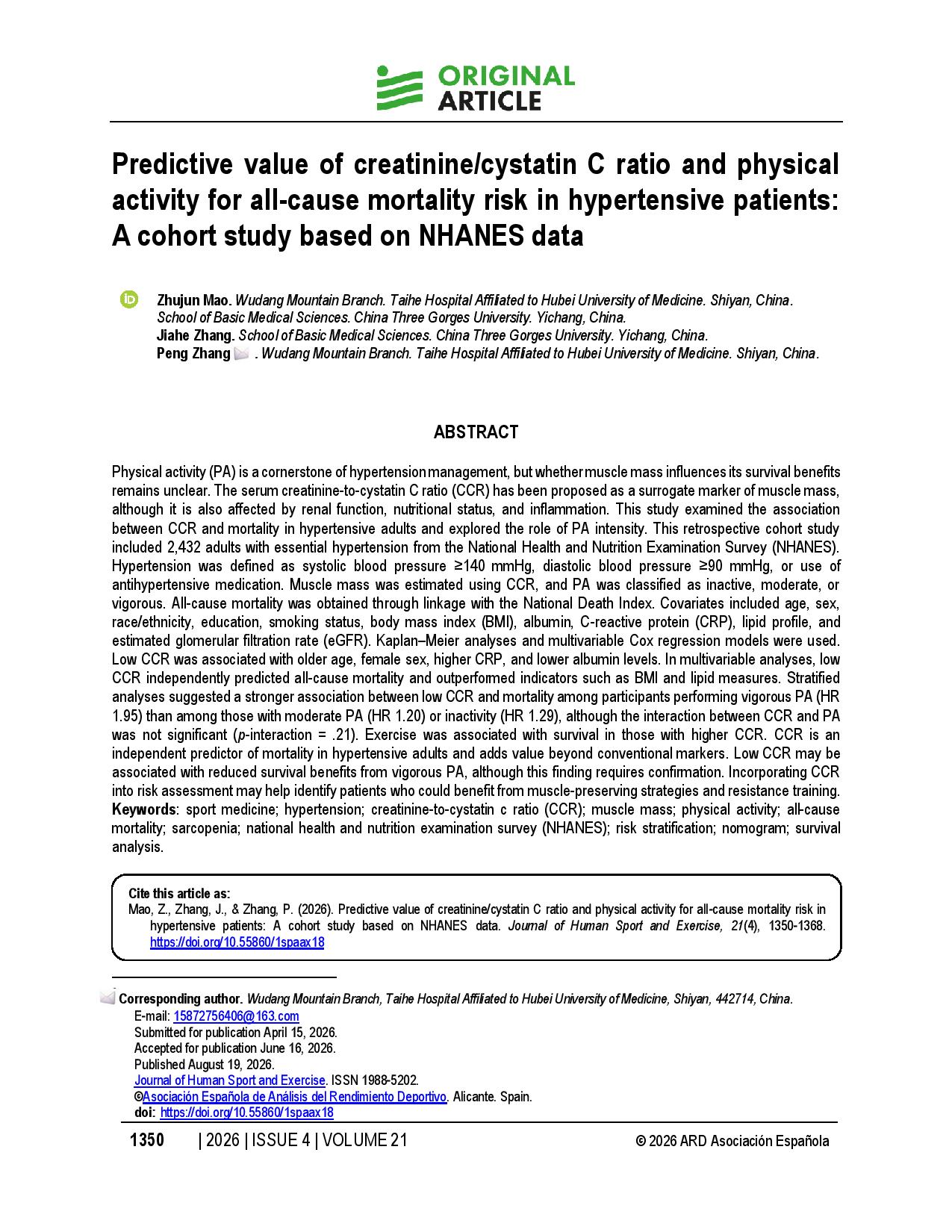
Predictive value of creatinine/cystatin C ratio and physical activity for all-cause mortality risk in hypertensive patients A cohort study based on NHANES data
Article Sidebar
Main Article Content
Abstract
Physical activity (PA) is a cornerstone of hypertension management, but whether muscle mass influences its survival benefits remains unclear. The serum creatinine-to-cystatin C ratio (CCR) has been proposed as a surrogate marker of muscle mass, although it is also affected by renal function, nutritional status, and inflammation. This study examined the association between CCR and mortality in hypertensive adults and explored the role of PA intensity. This retrospective cohort study included 2,432 adults with essential hypertension from the National Health and Nutrition Examination Survey (NHANES). Hypertension was defined as systolic blood pressure ≥140 mmHg, diastolic blood pressure ≥90 mmHg, or use of antihypertensive medication. Muscle mass was estimated using CCR, and PA was classified as inactive, moderate, or vigorous. All-cause mortality was obtained through linkage with the National Death Index. Covariates included age, sex, race/ethnicity, education, smoking status, body mass index (BMI), albumin, C-reactive protein (CRP), lipid profile, and estimated glomerular filtration rate (eGFR). Kaplan–Meier analyses and multivariable Cox regression models were used. Low CCR was associated with older age, female sex, higher CRP, and lower albumin levels. In multivariable analyses, low CCR independently predicted all-cause mortality and outperformed indicators such as BMI and lipid measures. Stratified analyses suggested a stronger association between low CCR and mortality among participants performing vigorous PA (HR 1.95) than among those with moderate PA (HR 1.20) or inactivity (HR 1.29), although the interaction between CCR and PA was not significant (p-interaction = .21). Exercise was associated with survival in those with higher CCR. CCR is an independent predictor of mortality in hypertensive adults and adds value beyond conventional markers. Low CCR may be associated with reduced survival benefits from vigorous PA, although this finding requires confirmation. Incorporating CCR into risk assessment may help identify patients who could benefit from muscle-preserving strategies and resistance training.
Downloads
Article Details
Section

This work is licensed under a Creative Commons Attribution-NonCommercial-ShareAlike 4.0 International License.
Each author warrants that his or her submission to the Work is original and that he or she has full power to enter into this agreement. Neither this Work nor a similar work has been published elsewhere in any language nor shall be submitted for publication elsewhere while under consideration by Journal of Human Sport and Exercise (JHSE). Each author also accepts that the JHSE will not be held legally responsible for any claims of compensation.
Authors wishing to include figures or text passages that have already been published elsewhere are required to obtain permission from the copyright holder(s) and to include evidence that such permission has been granted when submitting their papers. Any material received without such evidence will be assumed to originate from the authors.
Please include at the end of the acknowledgements a declaration that the experiments comply with the current laws of the country in which they were performed. The editors reserve the right to reject manuscripts that do not comply with the abovementioned requirements. The author(s) will be held responsible for false statements or failure to fulfill the above-mentioned requirements.
This title is licensed under a Attribution-NonCommercial-ShareAlike 4.0 International (CC BY-NC-SA 4.0).
You are free to:
Share — copy and redistribute the material in any medium or format.
Adapt — remix, transform, and build upon the material.
The licensor cannot revoke these freedoms as long as you follow the license terms.
Under the following terms:
-
Attribution — You must give appropriate credit, provide a link to the license, and indicate if changes were made. You may do so in any reasonable manner, but not in any way that suggests the licensor endorses you or your use.
-
NonCommercial — You may not use the material for commercial purposes.
-
ShareAlike — If you remix, transform, or build upon the material, you must distribute your contributions under the same license as the original.
- No additional restrictions — You may not apply legal terms or technological measures that legally restrict others from doing anything the license permits.
Notices:
- You do not have to comply with the license for elements of the material in the public domain or where your use is permitted by an applicable exception or limitation.
- No warranties are given. The license may not give you all of the permissions necessary for your intended use. For example, other rights such as publicity, privacy, or moral rights may limit how you use the material.
How to Cite




References
Ahluwalia, N., Dwyer, J., Terry, A., Moshfegh, A., & Johnson, C. (2016). Update on NHANES dietary data: Focus on collection, release, analytical considerations, and uses to inform public policy. Advances in Nutrition, 7(1), 121–134. https://doi.org/10.3945/an.115.009258 DOI: https://doi.org/10.3945/an.115.009258
Argilés, J. M., Campos, N., Lopez-Pedrosa, J. M., Rueda, R., & Rodriguez-Mañas, L. (2016). Skeletal muscle regulates metabolism via interorgan crosstalk: Roles in health and disease. Journal of the American Medical Directors Association, 17(9), 789–796. https://doi.org/10.1016/j.jamda.2016.04.019 DOI: https://doi.org/10.1016/j.jamda.2016.04.019
Batsis, J. A., & Villareal, D. T. (2018). Sarcopenic obesity in older adults: Aetiology, epidemiology and treatment strategies. Nature Reviews Endocrinology, 14(9), 513–537. https://doi.org/10.1038/s41574-018-0062-9 DOI: https://doi.org/10.1038/s41574-018-0062-9
Bauer, J., Biolo, G., Cederholm, T., Cesari, M., Cruz-Jentoft, A. J., Morley, J. E., Phillips, S., Sieber, C., Stehle, P., Teta, D., Visvanathan, R., Volpi, E., & Boirie, Y. (2013). Evidence-based recommendations for optimal dietary protein intake in older people: A position paper from the PROT-AGE Study Group. Journal of the American Medical Directors Association, 14(8), 542–559. https://doi.org/10.1016/j.jamda.2013.05.021 DOI: https://doi.org/10.1016/j.jamda.2013.05.021
Beasley, J. M., Shikany, J. M., & Thomson, C. A. (2013). The role of dietary protein intake in the prevention of sarcopenia of aging. Nutrition in Clinical Practice, 28(6), 684–690. https://doi.org/10.1177/0884533613507607 DOI: https://doi.org/10.1177/0884533613507607
Benetos, A., Petrovic, M., & Strandberg, T. (2019). Hypertension management in older and frail older patients. Circulation Research, 124(7), 1045–1060. https://doi.org/10.1161/CIRCRESAHA.118.313236 DOI: https://doi.org/10.1161/CIRCRESAHA.118.313236
Boström, P., Wu, J., Jedrychowski, M. P., Korde, A., Ye, L., Lo, J. C., Rasbach, K. A., Boström, E. A., Choi, J. H., Long, J. Z., Kajimura, S., Zingaretti, M. C., Vind, B. F., Tu, H., Cinti, S., Højlund, K., Gygi, S. P., & Spiegelman, B. M. (2012). A PGC1-α-dependent myokine that drives brown-fat-like development of white fat and thermogenesis. Nature, 481(7382), 463–468. https://doi.org/10.1038/nature10777 DOI: https://doi.org/10.1038/nature10777
Bouchard, C., Blair, S. N., Church, T. S., Earnest, C. P., Hagberg, J. M., Häkkinen, K., Jenkins, N. T., Karavirta, L., Kraus, W. E., Leon, A. S., Rao, D. C., Sarzynski, M. A., Skinner, J. S., Slentz, C. A., & Rankinen, T. (2012). Adverse metabolic response to regular exercise: Is it a rare or common occurrence? PLOS ONE, 7(5), e37887. https://doi.org/10.1371/journal.pone.0037887 DOI: https://doi.org/10.1371/journal.pone.0037887
Bull, F. C., Al-Ansari, S. S., Biddle, S., Borodulin, K., Buman, M. P., Cardon, G., Carty, C., Chaput, J.-P., Chastin, S., Chou, R., Dempsey, P. C., DiPietro, L., Ekelund, U., Firth, J., Friedenreich, C. M., Garcia, L., Gichu, M., Jago, R., Katzmarzyk, P. T., … Willumsen, J. F. (2020). World Health Organization 2020 guidelines on physical activity and sedentary behaviour. British Journal of Sports Medicine, 54(24), 1451–1462. https://doi.org/10.1136/bjsports-2020-102955 DOI: https://doi.org/10.1136/bjsports-2020-102955
Cadore, E. L., & Izquierdo, M. (2015). Exercise interventions in polypathological aging patients that coexist with diabetes mellitus: Improving functional status and quality of life. AGE, 37(3), 64. https://doi.org/10.1007/s11357-015-9800-2 DOI: https://doi.org/10.1007/s11357-015-9800-2
Chen, D. C., Shlipak, M. G., Scherzer, R., Bauer, S. R., Potok, O. A., Rifkin, D. E., Ix, J. H., Muiru, A. N., Hsu, C., & Estrella, M. M. (2022). Association of intraindividual difference in estimated glomerular filtration rate by creatinine vs cystatin C and end-stage kidney disease and mortality. JAMA Network Open, 5(2), e2148940. https://doi.org/10.1001/jamanetworkopen.2021.48940 DOI: https://doi.org/10.1001/jamanetworkopen.2021.48940
Delanaye, P., Cavalier, E., & Pottel, H. (2017). Serum creatinine: Not so simple! Nephron, 136(4), 302–308. https://doi.org/10.1159/000469669 DOI: https://doi.org/10.1159/000469669
Eijsvogels, T. M. H., Molossi, S., Lee, D., Emery, M. S., & Thompson, P. D. (2016). Exercise at the Extremes. JACC, 67(3), 316-329. https://doi.org/10.1016/j.jacc.2015.11.034 DOI: https://doi.org/10.1016/j.jacc.2015.11.034
Ferrucci, L., & Fabbri, E. (2018). Inflammageing: Chronic inflammation in ageing, cardiovascular disease, and frailty. Nature Reviews Cardiology, 15(9), 505-522. https://doi.org/10.1038/s41569-018-0064-2 DOI: https://doi.org/10.1038/s41569-018-0064-2
Fragala, M. S., Cadore, E. L., Dorgo, S., Izquierdo, M., Kraemer, W. J., Peterson, M. D., & Ryan, E. D. (2019). Resistance training for older adults: Position statement from the national strength and conditioning association. The Journal of Strength & Conditioning Research, 33(8), 2019. https://doi.org/10.1519/JSC.0000000000003230 DOI: https://doi.org/10.1519/JSC.0000000000003230
Franklin, B. A., Thompson, P. D., Al-Zaiti, S. S., Albert, C. M., Hivert, M.-F., Levine, B. D., Lobelo, F., Madan, K., Sharrief, A. Z., Eijsvogels, T. M. H., & On behalf of the American Heart Association Physical Activity Committee of the Council on Lifestyle and Cardiometabolic Health; Council on Cardiovascular and Stroke Nursing; Council on Clinical Cardiology; and Stroke Council. (2020). Exercise-Related Acute Cardiovascular Events and Potential Deleterious Adaptations Following Long-Term Exercise Training: Placing the Risks Into Perspective-An Update: A Scientific Statement From the American Heart Association. Circulation, 141(13), e705-e736. https://doi.org/10.1161/CIR.0000000000000749 DOI: https://doi.org/10.1161/CIR.0000000000000749
Izquierdo, M., Merchant, R. A., Morley, J. E., Anker, S. D., Aprahamian, I., Arai, H., Aubertin-Leheudre, M., Bernabei, R., Cadore, E. L., Cesari, M., Chen, L.-K., de Souto Barreto, P., Duque, G., Ferrucci, L., Fielding, R. A., García-Hermoso, A., Gutiérrez-Robledo, L. M., Harridge, S. D. R., Kirk, B., … Singh, M. F. (2021). International exercise recommendations in older adults (ICFSR): Expert consensus guidelines. The Journal of Nutrition, Health & Aging, 25(7), 824-853. https://doi.org/10.1007/s12603-021-1665-8 DOI: https://doi.org/10.1007/s12603-021-1665-8
Ji, L. L., Kang, C., & Zhang, Y. (2016). Exercise-induced hormesis and skeletal muscle health. Free Radical Biology and Medicine, 98, 113-122. https://doi.org/10.1016/j.freeradbiomed.2016.02.025 DOI: https://doi.org/10.1016/j.freeradbiomed.2016.02.025
Kattan, M. W. (2003). Nomograms are superior to staging and risk grouping systems for identifying high-risk patients: Preoperative application in prostate cancer. Current Opinion in Urology, 13(2), 111. https://doi.org/10.1097/00042307-200303000-00005 DOI: https://doi.org/10.1097/00042307-200303000-00005
Kirkman, D. L., Bohmke, N., Carbone, S., Garten, R. S., Rodriguez-Miguelez, P., Franco, R. L., Kidd, J. M., & Abbate, A. (2021). Exercise intolerance in kidney diseases: Physiological contributors and therapeutic strategies. American Journal of Physiology-Renal Physiology, 320(2), F161-F173. https://doi.org/10.1152/ajprenal.00437.2020 DOI: https://doi.org/10.1152/ajprenal.00437.2020
Knight, E. L., Verhave, J. C., Spiegelman, D., Hillege, H. L., De Zeeuw, D., Curhan, G. C., & De Jong, P. E. (2004). Factors influencing serum cystatin C levels other than renal function and the impact on renal function measurement. Kidney International, 65(4), 1416-1421. https://doi.org/10.1111/j.1523-1755.2004.00517.x DOI: https://doi.org/10.1111/j.1523-1755.2004.00517.x
Liao, Y., Hu, H. Fei, & Song, H. (2025). Association between the haemoglobin glycation index and risk of cardiovascular disease in the CKM syndrome stage 0-3 (SSRN Scholarly Paper No. 5527825). Social Science Research Network. https://doi.org/10.2139/ssrn.5527825 DOI: https://doi.org/10.2139/ssrn.5527825
McPhee, J. S., French, D. P., Jackson, D., Nazroo, J., Pendleton, N., & Degens, H. (2016). Physical activity in older age: Perspectives for healthy ageing and frailty. Biogerontology, 17(3), 567-580. https://doi.org/10.1007/s10522-016-9641-0 DOI: https://doi.org/10.1007/s10522-016-9641-0
Mills, K. T., Stefanescu, A., & He, J. (2020). The global epidemiology of hypertension. Nature Reviews Nephrology, 16(4), 223-237. https://doi.org/10.1038/s41581-019-0244-2 DOI: https://doi.org/10.1038/s41581-019-0244-2
Mons, U., Hahmann, H., & Brenner, H. (2014). A reverse J-shaped association of leisure time physical activity with prognosis in patients with stable coronary heart disease: evidence from a large cohort with repeated measurements. Heart, 100(13), 1043–1049. https://doi.org/10.1136/heartjnl-2013-305242 DOI: https://doi.org/10.1136/heartjnl-2013-305242
O'Keefe, J. H., Patil, H. R., Lavie, C. J., Magalski, A., Vogel, R. A., & McCullough, P. A. (2012). Potential adverse cardiovascular effects from excessive endurance exercise. Mayo Clinic Proceedings, 87(6), 587-595. https://doi.org/10.1016/j.mayocp.2012.04.005 DOI: https://doi.org/10.1016/j.mayocp.2012.04.005
Osaka, T., Hamaguchi, M., Hashimoto, Y., Ushigome, E., Tanaka, M., Yamazaki, M., & Fukui, M. (2018). Decreased the creatinine to cystatin C ratio is a surrogate marker of sarcopenia in patients with type 2 diabetes. Diabetes Research and Clinical Practice, 139, 52-58. https://doi.org/10.1016/j.diabres.2018.02.025 DOI: https://doi.org/10.1016/j.diabres.2018.02.025
Pedersen, B. K., & Febbraio, M. A. (2012). Muscles, exercise and obesity: Skeletal muscle as a secretory organ. Nature Reviews Endocrinology, 8(8), 457-465. https://doi.org/10.1038/nrendo.2012.49 DOI: https://doi.org/10.1038/nrendo.2012.49
Pencina, M. J., D' Agostino Sr, R. B., D' Agostino Jr, R. B., & Vasan, R. S. (2008). Evaluating the added predictive ability of a new marker: From area under the ROC curve to reclassification and beyond. Statistics in Medicine, 27(2), 157-172. https://doi.org/10.1002/sim.2929 DOI: https://doi.org/10.1002/sim.2929
Pickering, C., & Kiely, J. (2019). Do non-responders to exercise exist-And if so, what should we do about them? Sports Medicine, 49(1), 1-7. https://doi.org/10.1007/s40279-018-01041-1 DOI: https://doi.org/10.1007/s40279-018-01041-1
Piotrowicz, K., Klich-Rączka, A., Skalska, A., Gryglewska, B., Grodzicki, T., Gąsowski, J., Piotrowicz, K., Klich-Rączka, A., Skalska, A., Gryglewska, B., Grodzicki, T., & Gąsowski, J. (2022). Pulse wave velocity and sarcopenia in older persons-A systematic review and meta-analysis. International Journal of Environmental Research and Public Health, 19(11). https://doi.org/10.3390/ijerph19116477 DOI: https://doi.org/10.3390/ijerph19116477
Powers, S. K., Deminice, R., Ozdemir, M., Yoshihara, T., Bomkamp, M. P., & Hyatt, H. (2020). Exercise-induced oxidative stress: Friend or foe? Journal of Sport and Health Science, 9(5), 415-425. https://doi.org/10.1016/j.jshs.2020.04.001 DOI: https://doi.org/10.1016/j.jshs.2020.04.001
Prince, S. A., Adamo, K. B., Hamel, M. E., Hardt, J., Gorber, S. C., & Tremblay, M. (2008). A comparison of direct versus self-report measures for assessing physical activity in adults: A systematic review. International Journal of Behavioral Nutrition and Physical Activity, 5(1), 56. https://doi.org/10.1186/1479-5868-5-56 DOI: https://doi.org/10.1186/1479-5868-5-56
Radak, Z., Chung, H. Y., Koltai, E., Taylor, A. W., & Goto, S. (2008). Exercise, oxidative stress and hormesis. Ageing Research Reviews, 7(1), 34-42. https://doi.org/10.1016/j.arr.2007.04.004 DOI: https://doi.org/10.1016/j.arr.2007.04.004
Reid, K. F., & Fielding, R. A. (2012). Skeletal muscle power: A critical determinant of physical functioning in older adults. Exercise and Sport Sciences Reviews, 40(1), 4. https://doi.org/10.1097/JES.0b013e31823b5f13 DOI: https://doi.org/10.1097/JES.0b013e31823b5f13
Ren, C., Hu, T., Zhu, J., Chu, H., & Guo, Q. (2025). Sarcopenia index is associated with alzheimer's disease, mild cognitive impairment and their mortality in chinese adults aged 65 and older. BMC Public Health, 25, 2277. https://doi.org/10.1186/s12889-025-23512-7 DOI: https://doi.org/10.1186/s12889-025-23512-7
Richter, D., Guasti, L., Walker, D., Lambrinou, E., Lionis, C., Abreu, A., Savelieva, I., Fumagalli, S., Bo, M., Rocca, B., Jensen, M. T., Pierard, L., Sudano, I., Aboyans, V., & Asteggiano, R. (2022). Frailty in cardiology: Definition, assessment and clinical implications for general cardiology. A consensus document of the council for cardiology practice (CCP), association for acute cardio vascular care (ACVC), association of cardiovascular nursing and allied professions (ACNAP), european association of preventive cardiology (EAPC), european heart rhythm association (EHRA), council on valvular heart diseases (VHD), council on hypertension (CHT), council of cardio-oncology (CCO), working group (WG) aorta and peripheral vascular diseases, WG e-cardiology, WG thrombosis, of the european society of cardiology, european primary care cardiology society (EPCCS). European Journal of Preventive Cardiology, 29(1), 216-227. https://doi.org/10.1093/eurjpc/zwaa167 DOI: https://doi.org/10.1093/eurjpc/zwaa167
Rule, A. D., Larson, T. S., Bergstralh, E. J., Slezak, J. M., Jacobsen, S. J., & Cosio, F. G. (2004). Using serum creatinine to estimate glomerular filtration rate: Accuracy in good health and in chronic kidney disease. Annals of Internal Medicine, 141(12), 929-937. https://doi.org/10.7326/0003-4819-141-12-200412210-00009 DOI: https://doi.org/10.7326/0003-4819-141-12-200412210-00009
Sayer, A. A., & Kirkwood, T. B. L. (2015). Grip strength and mortality: A biomarker of ageing? The Lancet, 386(9990), 226-227. https://doi.org/10.1016/S0140-6736(14)62349-7 DOI: https://doi.org/10.1016/S0140-6736(14)62349-7
Sedgwick, P. (2015). Bias in observational study designs: cross sectional studies. BMJ, 350. https://doi.org/10.1136/bmj.h1286 DOI: https://doi.org/10.1136/bmj.h1286
Severinsen, M. C. K., & Pedersen, B. K. (2020). Muscle-organ crosstalk: The emerging roles of myokines. Endocrine Reviews, 41(4), 594-609. https://doi.org/10.1210/endrev/bnaa016 DOI: https://doi.org/10.1210/endrev/bnaa016
Shlipak, M. G., Matsushita, K., Ärnlöv, J., Inker, L. A., Katz, R., Polkinghorne, K. R., Rothenbacher, D., Sarnak, M. J., Astor, B. C., Coresh, J., Levey, A. S., & Gansevoort, R. T. (2013). Cystatin C versus creatinine in determining risk based on kidney function. New England Journal of Medicine, 369(10), 932-943. https://doi.org/10.1056/NEJMoa1214234 DOI: https://doi.org/10.1056/NEJMoa1214234
Simioni, C., Zauli, G., Martelli, A. M., Vitale, M., Sacchetti, G., Gonelli, A., & Neri, L. M. (2018). Oxidative stress: Role of physical exercise and antioxidant nutraceuticals in adulthood and aging. Oncotarget, 9(24), 17181-17198. https://doi.org/10.18632/oncotarget.24729 DOI: https://doi.org/10.18632/oncotarget.24729
Smith, R. L., Soeters, M. R., Wüst, R. C. I., & Houtkooper, R. H. (2018). Metabolic flexibility as an adaptation to energy resources and requirements in health and disease. Endocrine Reviews, 39(4), 489-517. https://doi.org/10.1210/er.2017-00211 DOI: https://doi.org/10.1210/er.2017-00211
Springer, J., Springer, J.-I., & Anker, S. D. (2017). Muscle wasting and sarcopenia in heart failure and beyond: Update 2017. ESC Heart Failure, 4(4), 492-498. https://doi.org/10.1002/ehf2.12237 DOI: https://doi.org/10.1002/ehf2.12237
Srikanthan, P., & Karlamangla, A. S. (2014). Muscle mass index As a predictor of longevity in older adults. The American Journal of Medicine, 127(6), 547-553. https://doi.org/10.1016/j.amjmed.2014.02.007 DOI: https://doi.org/10.1016/j.amjmed.2014.02.007
Tabara, Y., Kohara, K., Okada, Y., Ohyagi, Y., & Igase, M. (2020). Creatinine-to-cystatin C ratio as a marker of skeletal muscle mass in older adults: J-SHIPP study. Clinical Nutrition, 39(6), 1857-1862. https://doi.org/10.1016/j.clnu.2019.07.027 DOI: https://doi.org/10.1016/j.clnu.2019.07.027
Tang, T., Zhuo, Y., Xie, L., Wang, H., & Yang, M. (2020). Sarcopenia index based on serum creatinine and cystatin C is associated with 3-year mortality in hospitalized older patients. Scientific Reports, 10(1), 1260. https://doi.org/10.1038/s41598-020-58304-z DOI: https://doi.org/10.1038/s41598-020-58304-z
Tieland, M., Trouwborst, I., & Clark, B. C. (2018). Skeletal muscle performance and ageing. Journal of Cachexia, Sarcopenia and Muscle, 9(1), 3-19. https://doi.org/10.1002/jcsm.12238 DOI: https://doi.org/10.1002/jcsm.12238
Troiano, R., Berrigan, D., Dodd, K., Mâsse, L., Tilert, T., & Mcdowell, M. (2008). Physical Activity in the United States Measured by Accelerometer. Medicine & Science in Sports & Exercise, 40(1), 181–188. https://doi.org/10.1249/mss.0b013e31815a51b3 DOI: https://doi.org/10.1249/mss.0b013e31815a51b3
VinÑa, J., Gomez-Cabrera, M.-C., Lloret, A., Marquez, R., Miñana, J. B., Pallardó, F. V., & Sastre, J. (2000). Free Radicals in Exhaustive Physical Exercise: Mechanism of Production, and Protection by Antioxidants. IUBMB Life, 50(4-5), 271-277. https://doi.org/10.1080/713803729 DOI: https://doi.org/10.1080/713803729
Visser, M., Pahor, M., Taaffe, D. R., Goodpaster, B. H., Simonsick, E. M., Newman, A. B., Nevitt, M., & Harris, T. B. (2002). Relationship of interleukin-6 and tumor necrosis factor-α with muscle mass and muscle strength in elderly men and women: The health ABC study. The Journals of Gerontology: Series A, 57(5), M326-M332. https://doi.org/10.1093/gerona/57.5.M326 DOI: https://doi.org/10.1093/gerona/57.5.M326
Wannamethee, S. G., & Atkins, J. L. (2015). Muscle loss and obesity: The health implications of sarcopenia and sarcopenic obesity. Proceedings of the Nutrition Society, 74(4), 405-412. https://doi.org/10.1017/S002966511500169X DOI: https://doi.org/10.1017/S002966511500169X
Whelton, P. K., Carey, R. M., Aronow, W. S., Casey, D. E., Collins, K. J., Himmelfarb, C. D., DePalma, S. M., Gidding, S., Jamerson, K. A., Jones, D. W., MacLaughlin, E. J., Muntner, P., Ovbiagele, B., Smith, S. C., Spencer, C. C., Stafford, R. S., Taler, S. J., Thomas, R. J., Williams, K. A., … Wright, J. T. (2018). 2017 ACC/AHA/AAPA/ABC/ACPM/AGS/APhA/ASH/ASPC/NMA/PCNA Guideline for the Prevention, Detection, Evaluation, and Management of High Blood Pressure in Adults. JACC, 71(19), e127–e248. https://doi.org/10.1016/j.jacc.2017.11.006 DOI: https://doi.org/10.1016/j.jacc.2017.11.006
Wolfe, R. R. (2006). The underappreciated role of muscle in health and disease. The American Journal of Clinical Nutrition, 84(3), 475-482. https://doi.org/10.1093/ajcn/84.3.475 DOI: https://doi.org/10.1093/ajcn/84.3.475
Yoshimura, Y., Wakabayashi, H., Yamada, M., Kim, H., Harada, A., & Arai, H. (2017). Interventions for treating sarcopenia: A systematic review and meta-analysis of randomized controlled studies. Journal of the American Medical Directors Association, 18(6), 553.e1-553.e16. https://doi.org/10.1016/j.jamda.2017.03.019 DOI: https://doi.org/10.1016/j.jamda.2017.03.019