The impact of physical activity participation on subjective well-being among middle-aged adults The parallel mediating roles of perceived social fairness and aging anxiety
Article Sidebar
Main Article Content
Abstract
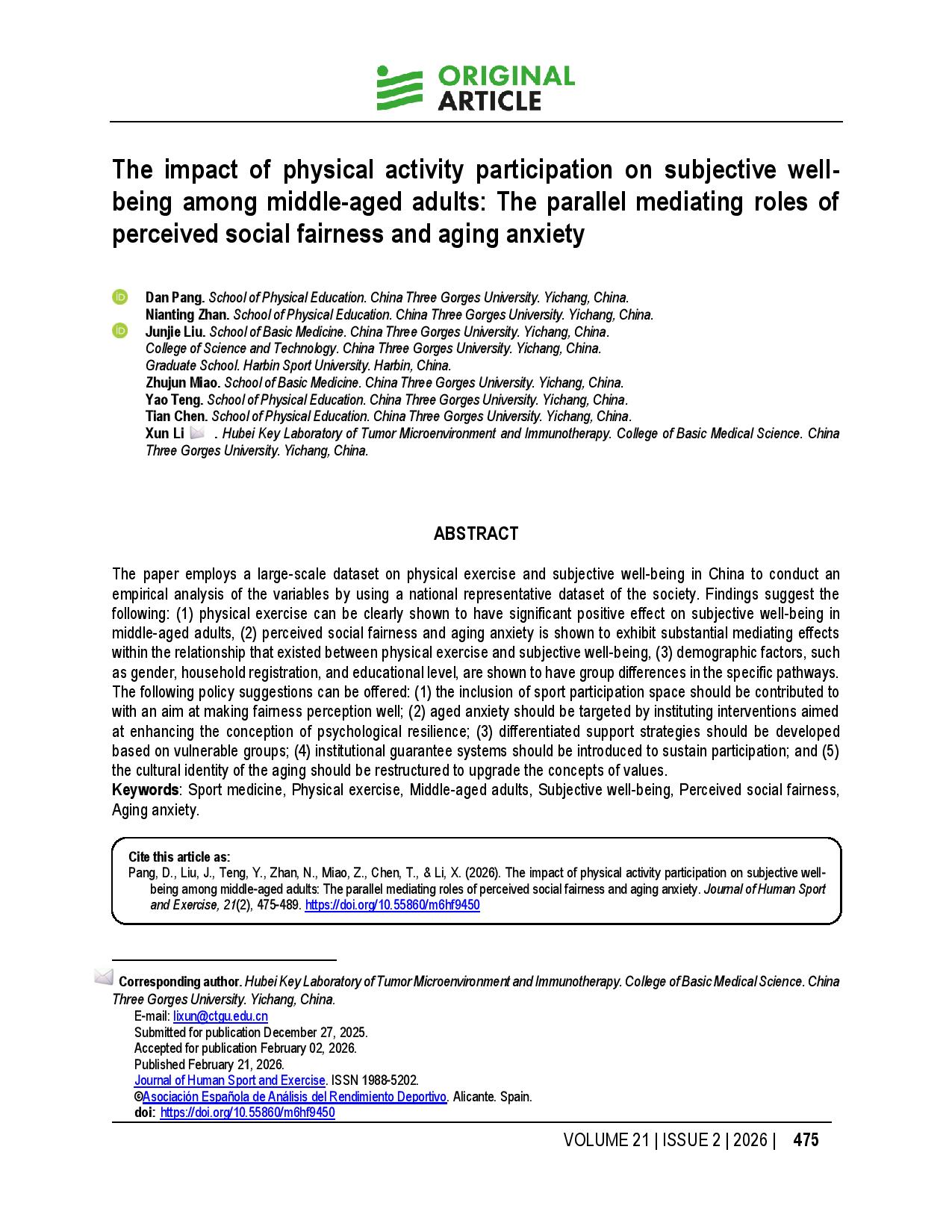
The paper employs a large-scale dataset on physical exercise and subjective well-being in China to conduct an empirical analysis of the variables by using a national representative dataset of the society. Findings suggest the following: (1) physical exercise can be clearly shown to have significant positive effect on subjective well-being in middle-aged adults, (2) perceived social fairness and aging anxiety is shown to exhibit substantial mediating effects within the relationship that existed between physical exercise and subjective well-being, (3) demographic factors, such as gender, household registration, and educational level, are shown to have group differences in the specific pathways. The following policy suggestions can be offered: (1) the inclusion of sport participation space should be contributed to with an aim at making fairness perception well; (2) aged anxiety should be targeted by instituting interventions aimed at enhancing the conception of psychological resilience; (3) differentiated support strategies should be developed based on vulnerable groups; (4) institutional guarantee systems should be introduced to sustain participation; and (5) the cultural identity of the aging should be restructured to upgrade the concepts of values.
Downloads
Article Details
Section

This work is licensed under a Creative Commons Attribution-NonCommercial-ShareAlike 4.0 International License.
Each author warrants that his or her submission to the Work is original and that he or she has full power to enter into this agreement. Neither this Work nor a similar work has been published elsewhere in any language nor shall be submitted for publication elsewhere while under consideration by Journal of Human Sport and Exercise (JHSE). Each author also accepts that the JHSE will not be held legally responsible for any claims of compensation.
Authors wishing to include figures or text passages that have already been published elsewhere are required to obtain permission from the copyright holder(s) and to include evidence that such permission has been granted when submitting their papers. Any material received without such evidence will be assumed to originate from the authors.
Please include at the end of the acknowledgements a declaration that the experiments comply with the current laws of the country in which they were performed. The editors reserve the right to reject manuscripts that do not comply with the abovementioned requirements. The author(s) will be held responsible for false statements or failure to fulfill the above-mentioned requirements.
This title is licensed under a Attribution-NonCommercial-ShareAlike 4.0 International (CC BY-NC-SA 4.0).
You are free to:
Share — copy and redistribute the material in any medium or format.
Adapt — remix, transform, and build upon the material.
The licensor cannot revoke these freedoms as long as you follow the license terms.
Under the following terms:
-
Attribution — You must give appropriate credit, provide a link to the license, and indicate if changes were made. You may do so in any reasonable manner, but not in any way that suggests the licensor endorses you or your use.
-
NonCommercial — You may not use the material for commercial purposes.
-
ShareAlike — If you remix, transform, or build upon the material, you must distribute your contributions under the same license as the original.
- No additional restrictions — You may not apply legal terms or technological measures that legally restrict others from doing anything the license permits.
Notices:
- You do not have to comply with the license for elements of the material in the public domain or where your use is permitted by an applicable exception or limitation.
- No warranties are given. The license may not give you all of the permissions necessary for your intended use. For example, other rights such as publicity, privacy, or moral rights may limit how you use the material.
How to Cite




Funding data
-
China Three Gorges University
Grant numbers 2025BYQ12
References
Adams, J. S. (1963). Towards an understanding of inequity. The journal of abnormal and social psychology, 67(5), 422. https://doi.org/10.1037/h0040968
Adamson, B., Adamson, M., & Clarke, C. (2022). Social justice through sport and exercise studies: A manifesto. Journal of Sport and Social Issues, 46(5), 407-444. https://doi.org/10.1177/01937235221099150
An, H. Y., Chen, W., Wang, C. W., Yang, H. F., Huang, W. T., & Fan, S. Y. (2020). The Relationships between Physical Activity and Life Satisfaction and Happiness among Young, Middle-Aged, and Older Adults. Int J Environ Res Public Health, 17(13). https://doi.org/10.3390/ijerph17134817
Asmundson, G. J., Fetzner, M. G., Deboer, L. B., Powers, M. B., Otto, M. W., & Smits, J. A. (2013). Let's get physical: a contemporary review of the anxiolytic effects of exercise for anxiety and its disorders. Depress Anxiety, 30(4), 362-373. https://doi.org/10.1002/da.22043
Bae, M. H. (2022). Happiness Levels and Leisure Life Satisfaction for Sports Leisure Activities Participation: Implication for Physical Education in Korea. Iran J Public Health, 51(9), 2007-2016. https://doi.org/10.18502/ijph.v51i9.10555
Balish, S. M., Conacher, D., & Dithurbide, L. (2016). Sport and Recreation Are Associated With Happiness Across Countries. Res Q Exerc Sport, 87(4), 382-388. https://doi.org/10.1080/02701367.2016.1229863
Baltes, P. B., & Smith, J. (2003). New frontiers in the future of aging: from successful aging of the young old to the dilemmas of the fourth age. Gerontology, 49(2), 123-135. https://doi.org/10.1159/000067946
Biernat, E., Nalecz, H., Skrok, L., & Majcherek, D. (2020). Do Sports Clubs Contribute to the Accumulation of Regional Social Capital? Int J Environ Res Public Health, 17(14). https://doi.org/10.3390/ijerph17145257
Chen, C., Tsai, L. T., Lin, C. F., Huang, C. C., Chang, Y. T., Chen, R. Y., & Lyu, S. Y. (2017). Factors influencing interest in recreational sports participation and its rural-urban disparity. PLoS One, 12(5), e0178052. https://doi.org/10.1371/journal.pone.0178052
Cho, J., Martin, P., Poon, L. W., & Georgia Centenarian, S. (2015). Successful aging and subjective well-being among oldest-old adults. Gerontologist, 55(1), 132-143. https://doi.org/10.1093/geront/gnu074
Danner, D. D., Snowdon, D. A., & Friesen, W. V. (2001). Positive emotions in early life and longevity: findings from the nun study. J Pers Soc Psychol, 80(5), 804-813. https://doi.org/10.1037/0022-3514.80.5.804
de Oliveira, L., Souza, E. C., Rodrigues, R. A. S., Fett, C. A., & Piva, A. B. (2019). The effects of physical activity on anxiety, depression, and quality of life in elderly people living in the community. Trends Psychiatry Psychother, 41(1), 36-42. https://doi.org/10.1590/2237-6089-2017-0129
De Souza, L. N. N., De Carvalho, P. H. B., & Ferreira, M. E. C. (2018). Quality of life and subjective well-being of physically active elderly people: a systematic review. Journal of Physical Education and Sport, 2018(03). https://doi.org/10.7752/jpes.2018.03237
Di Bartolomeo, G., & Papa, S. (2019). The effects of physical activity on social interactions: The case of trust and trustworthiness. Journal of Sports Economics, 20(1), 50-71. https://doi.org/10.1177/1527002517717299
Diener, E. (2012). New findings and future directions for subjective well-being research. Am Psychol, 67(8), 590-597. https://doi.org/10.1037/a0029541
Dings, A., & Spinath, F. M. (2024). Sports club participation impacts life satisfaction in adolescence: A twin study. Psychol Sport Exerc, 73, 102639. https://doi.org/10.1016/j.psychsport.2024.102639
Ewuzie, Z., Ezeano, C., & Aderinto, N. (2024). A review of exercise interventions for reducing anxiety symptoms: Insights and implications. Medicine (Baltimore), 103(41), e40084. https://doi.org/10.1097/MD.0000000000040084
Fang, C., & An, Z. ( 2024). Mechanism and micro-evidence of the impact of physical exercise participation on household consumption carbon emissions. Journal of Xi'an Physical Education University, 41(2), 205-216+280.
Ferrer-Uris, B., Ramos, M. A., Busquets, A., & Angulo-Barroso, R. (2022). Can exercise shape your brain? A review of aerobic exercise effects on cognitive function and neuro-physiological underpinning mechanisms. AIMS Neurosci, 9(2), 150-174. https://doi.org/10.3934/Neuroscience.2022009
Foster, L., & Walker, A. (2021). Active Ageing across the Life Course: Towards a Comprehensive Approach to Prevention. Biomed Res Int, 2021, 6650414. https://doi.org/10.1155/2021/6650414
Gao, S., & Zhao, J. (2021). The Influence of Perception of Social Equality and Social Trust on Subjective Well-Being Among Rural Chinese People: The Moderator Role of Education. Front Psychol, 12, 731982. https://doi.org/10.3389/fpsyg.2021.731982
Gill, D. L., Hammond, C. C., Reifsteck, E. J., Jehu, C. M., Williams, R. A., Adams, M. M., . . . Shang, Y. T. (2013). Physical activity and quality of life. J Prev Med Public Health, 46 Suppl 1(Suppl 1), S28-34. https://doi.org/10.3961/jpmph.2013.46.S.S28
Goodwin, G. M., & Stein, D. J. (2021). Generalised Anxiety Disorder and Depression: Contemporary Treatment Approaches. Adv Ther, 38(Suppl 2), 45-51. https://doi.org/10.1007/s12325-021-01859-8
Hallmann, K., Breuer, C., & Beermann, S. (2023). Facilitating sporting and non-sporting career goals of elite athletes through mentoring programmes. European Sport Management Quarterly, 23, 1200-1220. https://doi.org/10.1080/16184742.2021.1967420
Huang, H., & Humphreys, B. R. (2010). Sports Participation and Happiness: Evidence from U.S. Micro Data. https://doi.org/10.4337/9780857930149.00013
Hunte, H. E., & Williams, D. R. (2009). The association between perceived discrimination and obesity in a population-based multiracial and multiethnic adult sample. Am J Public Health, 99(7), 1285-1292. https://doi.org/10.2105/AJPH.2007.128090
Kim, A. C. H., Ryu, J., Lee, C., Kim, K. M., & Heo, J. (2021). Sport participation and happiness among older adults: A mediating role of social capital. Journal of Happiness Studies, 22, 1623-1641. https://doi.org/10.1007/s10902-020-00288-8
Lara, R., Vazquez, M. L., Ogallar, A., & Godoy-Izquierdo, D. (2020). Psychosocial Resources for Hedonic Balance, Life Satisfaction and Happiness in the Elderly: A Path Analysis. Int J Environ Res Public Health, 17(16). https://doi.org/10.3390/ijerph17165684
Li, C., Ning, G., & Xia, Y. (2023). Does exercise participation promote happiness?: Mediations and heterogeneities. Front Public Health, 11, 1033157. https://doi.org/10.3389/fpubh.2023.1033157
Liu, Y., Li, L., Miao, G., Yang, X., Wu, Y., Xu, Y., & Yang, S. (2021). Relationship between children's intergenerational emotional support and subjective well-being among middle-aged and elderly people in China: The mediation role of the sense of social fairness. International Journal of Environmental Research and Public Health, 19(1), 389. https://doi.org/10.3390/ijerph19010389
Lukaschek, K., Vanajan, A., Johar, H., Weiland, N., & Ladwig, K. H. (2017). "In the mood for ageing": determinants of subjective well-being in older men and women of the population-based KORA-Age study. BMC Geriatr, 17(1), 126. https://doi.org/10.1186/s12877-017-0513-5
Lynch, S. M. (2000). Measurement and prediction of aging anxiety. Research on Aging, 22(5), 533-558. https://doi.org/10.1177/0164027500225004
McHale, I., & Forrest, D. (2009). Public policy, sport and happiness: an empirical study working paper.
Meier, L. L., Semmer, N. K., & Hupfeld, J. (2009). The impact of unfair treatment on depressive mood: the moderating role of self-esteem level and self-esteem instability. Pers Soc Psychol Bull, 35(5), 643-655. https://doi.org/10.1177/0146167208331337
Moreno-Llamas, A., & García-Mayor, J. D. L. C.-S., E. (2022). Gender inequality is associated with gender differences and women participation in physical activity. Journal of Public Health, 44, e519-e526. https://doi.org/10.1093/pubmed/fdab354
Okely, J. A., & Gale, C. R. (2016). Well-Being and Chronic Disease Incidence: The English Longitudinal Study of Ageing. Psychosom Med, 78(3), 335-344. https://doi.org/10.1097/PSY.0000000000000279
Patria, B. (2022). Modeling the effects of physical activity, education, health, and subjective wealth on happiness based on Indonesian national survey data. BMC Public Health, 22(1), 959. https://doi.org/10.1186/s12889-022-13371-x
Peng, L., Yang, Z., Chang, D., & Liu, C. (2025). Disparities in sports participation behavior among Chinese residents. Scientific Reports, 15, 8788. https://doi.org/10.1038/s41598-025-92865-1
Powell, P. A. (2018). Individual differences in emotion regulation moderate the associations between empathy and affective distress. Motiv Emot, 42(4), 602-613. https://doi.org/10.1007/s11031-018-9684-4
Ramírez, L., & Palacios-Espinosa, X. (2016). Stereotypes about old age, social support, aging anxiety and evaluations of one's own health. Journal of Social Issues, 72(1), 47-68. https://doi.org/10.1111/josi.12155
Ravari, A., Mirzaei, T., Bahremand, R., Raeisi, M., & Kamiab, Z. (2021). The effect of Pilates exercise on the happiness and depression of elderly women: a clinical trial study. J Sports Med Phys Fitness, 61(1), 131-139. https://doi.org/10.23736/S0022-4707.20.10730-8
Ruseski, J. E., Humphreys, B. R., & Hallmann, K. (2014). Sport participation and subjective well-being: Instrumental variable results from German survey data. Journal of Physical Activity and Health, 11(2), 396-403. https://doi.org/10.1123/jpah.2012-0001
Scarpa, M. P., Di Martino, S., & Prilleltensky, I. (2021). Mattering Mediates Between Fairness and Well-being. Front Psychol, 12, 744201. https://doi.org/10.3389/fpsyg.2021.744201
Stellar, J. E., John-Henderson, N., Anderson, C. L., Gordon, A. M., McNeil, G. D., & Keltner, D. (2015). Positive affect and markers of inflammation: discrete positive emotions predict lower levels of inflammatory cytokines. Emotion, 15(2), 129-133. https://doi.org/10.1037/emo0000033
Sui, X., Zhao, B., & Liu, J. (2023). The impact of physical exercise participation on Chinese residents' sense of social equity: An empirical analysis based on CGSS2021 data. China Sport Science and Technology, 59(12), 18-24.
Sui, X., Zhao, B., Na, D., Liu, J., & Zhang, Q. (2024). The relationship between physical exercise and sense of social fairness among college students: the chain-mediated role of perceived social support and life satisfaction. Frontiers in Psychology, 15, 1430492. https://doi.org/10.3389/fpsyg.2024.1430492
Talebpour, A., Nazari Azad, M., & Kashani, M. (2019). Sociological analysis of gender inequality in sport (The perspective of female National Hero Athlete). Quarterly Journal of Woman and Society, 10, 289-316.
Ustundag, A., Haydaroglu, S., Sayan, D., & Gungor, M. (2025). The relationship between social anxiety levels and effective communication skills of adolescents participating in sports. Sci Rep, 15(1), 15724. https://doi.org/10.1038/s41598-025-00800-1
Woodman, T., Davis, P. A., Hardy, L., Callow, N., Glasscock, I., & Yuill-Proctor, J. (2009). Emotions and sport performance: an exploration of happiness, hope, and anger. J Sport Exerc Psychol, 31(2), 169-188. https://doi.org/10.1123/jsep.31.2.169
Yawar, R., Khan, S., Rafiq, M., Fawad, N., Shams, S., Navid, S., & Butt, T. A. (2024). Aging is inevitable: Understanding aging anxiety related to physical symptomology and quality of life with the mediating role of self-esteem in adults. International Journal of Human Rights in Healthcare, 17(2), 170-185. https://doi.org/10.1108/IJHRH-05-2022-0047
Yi, E. S., & Hwang, H. J. (2015). A study on the social behavior and social isolation of the elderly Korea. J Exerc Rehabil, 11(3), 125-132. https://doi.org/10.12965/jer.150215
Zhi, K., Tan, Q., Chen, S., Chen, Y., Wu, X., Xue, C., & Song, A. (2022). How does social security fairness predict trust in government? The serial mediation effects of social security satisfaction and life satisfaction. International Journal of Environmental Research and Public Health, 19(11), 6867. https://doi.org/10.3390/ijerph19116867