Factors related to shooting performance in 8–12-year-old basketball players
Article Sidebar
Main Article Content
Abstract
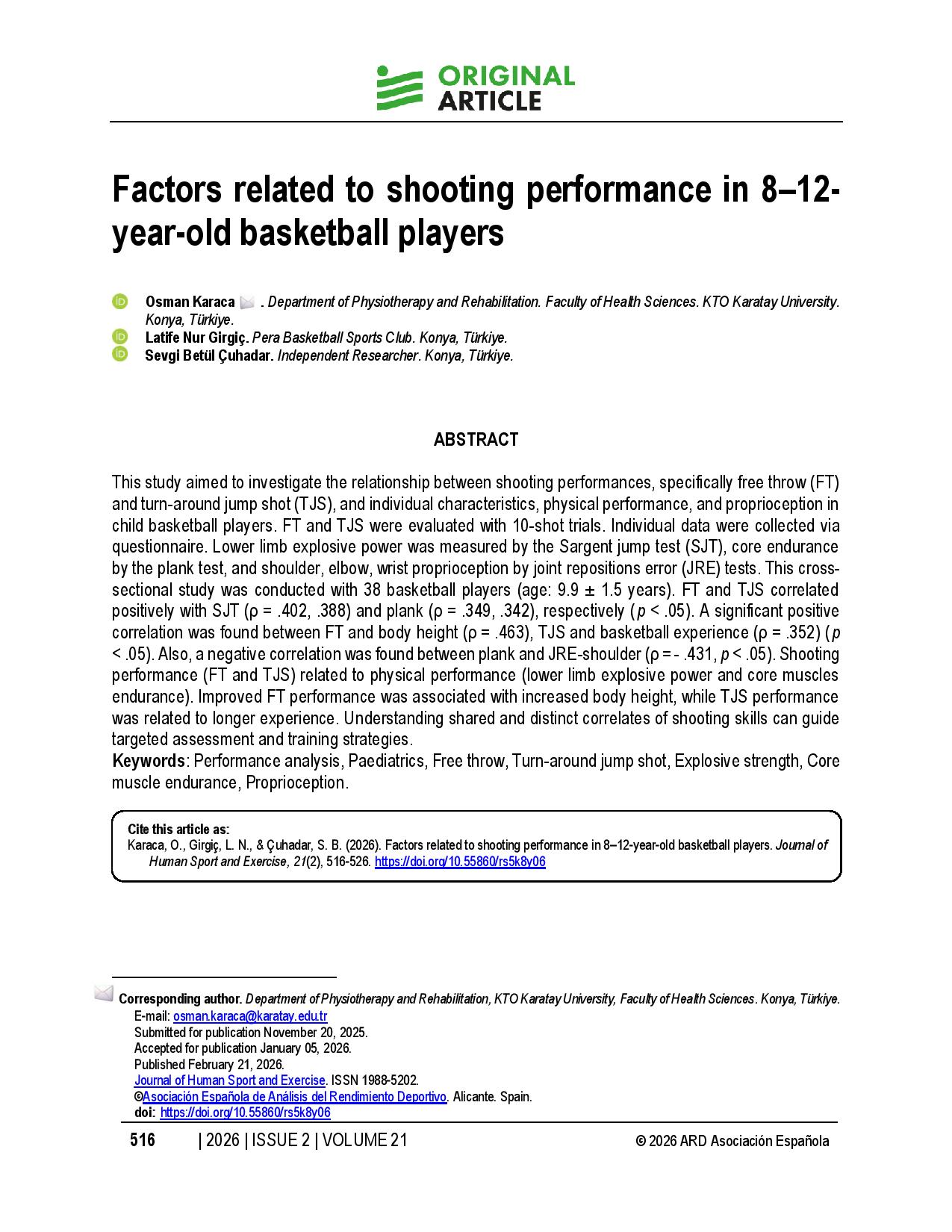
This study aimed to investigate the relationship between shooting performances, specifically free throw (FT) and turn-around jump shot (TJS), and individual characteristics, physical performance, and proprioception in child basketball players. FT and TJS were evaluated with 10-shot trials. Individual data were collected via questionnaire. Lower limb explosive power was measured by the Sargent jump test (SJT), core endurance by the plank test, and shoulder, elbow, wrist proprioception by joint repositions error (JRE) tests. This cross-sectional study was conducted with 38 basketball players (age: 9.9 ± 1.5 years). FT and TJS correlated positively with SJT (ρ = .402, .388) and plank (ρ = .349, .342), respectively (p < .05). A significant positive correlation was found between FT and body height (ρ = .463), TJS and basketball experience (ρ = .352) (p < .05). Also, a negative correlation was found between plank and JRE-shoulder (ρ = - .431, p < .05). Shooting performance (FT and TJS) related to physical performance (lower limb explosive power and core muscles endurance). Improved FT performance was associated with increased body height, while TJS performance was related to longer experience. Understanding shared and distinct correlates of shooting skills can guide targeted assessment and training strategies.
Downloads
Article Details
Section

This work is licensed under a Creative Commons Attribution-NonCommercial-ShareAlike 4.0 International License.
Each author warrants that his or her submission to the Work is original and that he or she has full power to enter into this agreement. Neither this Work nor a similar work has been published elsewhere in any language nor shall be submitted for publication elsewhere while under consideration by Journal of Human Sport and Exercise (JHSE). Each author also accepts that the JHSE will not be held legally responsible for any claims of compensation.
Authors wishing to include figures or text passages that have already been published elsewhere are required to obtain permission from the copyright holder(s) and to include evidence that such permission has been granted when submitting their papers. Any material received without such evidence will be assumed to originate from the authors.
Please include at the end of the acknowledgements a declaration that the experiments comply with the current laws of the country in which they were performed. The editors reserve the right to reject manuscripts that do not comply with the abovementioned requirements. The author(s) will be held responsible for false statements or failure to fulfill the above-mentioned requirements.
This title is licensed under a Attribution-NonCommercial-ShareAlike 4.0 International (CC BY-NC-SA 4.0).
You are free to:
Share — copy and redistribute the material in any medium or format.
Adapt — remix, transform, and build upon the material.
The licensor cannot revoke these freedoms as long as you follow the license terms.
Under the following terms:
-
Attribution — You must give appropriate credit, provide a link to the license, and indicate if changes were made. You may do so in any reasonable manner, but not in any way that suggests the licensor endorses you or your use.
-
NonCommercial — You may not use the material for commercial purposes.
-
ShareAlike — If you remix, transform, or build upon the material, you must distribute your contributions under the same license as the original.
- No additional restrictions — You may not apply legal terms or technological measures that legally restrict others from doing anything the license permits.
Notices:
- You do not have to comply with the license for elements of the material in the public domain or where your use is permitted by an applicable exception or limitation.
- No warranties are given. The license may not give you all of the permissions necessary for your intended use. For example, other rights such as publicity, privacy, or moral rights may limit how you use the material.
How to Cite




References
Bagesteiro, L. B., Sarlegna, F. R., & Sainburg, R. L. (2006). Differential influence of vision and proprioception on control of movement distance. Experimental Brain Research, 171(3), 358-370. https://doi.org/10.1007/s00221-005-0272-y
Cabarkapa, D., Eserhaut, D. A., Fry, A. C., Cabarkapa, D. V., Philipp, N. M., Whiting, S. M., & Downey, G. G. (2022). Relationship between upper and lower body strength and basketball shooting performance. Sports, 10(10), 139. https://doi.org/10.3390/sports10100139
Cengizhan, P. A., Cobanoglu, G., Gokdogan, C. M., Zorlular, A., Akaras, E., Orer, G. E., Kafa, N., & Guzel, N. A. (2019). The relationship between postural stability, core muscle endurance and agility in professional basketball players. https://doi.org/10.5455/annalsmedres.2019.07.436
do Amaral Vasconcellos, F. V., Fonseca, R. T., & Dantas, E. H. M. (2012). Validity and reproducibility of the sargent jump test in the assessment of explosive strength in soccer players. Journal of human kinetics, 33, 115. https://doi.org/10.2478/v10078-012-0050-4
Dos Reis, A. L., de Oliveira, L. C., & de Oliveira, R. G. (2024). Effects of stretching in a pilates program on musculoskeletal fitness: a randomized clinical trial. BMC Sports Science, Medicine and Rehabilitation, 16(1), 11. https://doi.org/10.1186/s13102-024-00808-6
Goodman, R., & Tremblay, L. (2018). Using proprioception to control ongoing actions: dominance of vision or altered proprioceptive weighing? Experimental Brain Research, 236(7), 1897-1910. https://doi.org/10.1007/s00221-018-5258-7
Gür, S., Soyal, M., & Doğan, Ö. (2022). Investigation of the relationship between vertical jump and core performance on competition shooting performance in elite female basketball players.
Han, J., Waddington, G., Adams, R., Anson, J., & Liu, Y. (2016). Assessing proprioception: a critical review of methods. Journal of sport and health science, 5(1), 80-90. https://doi.org/10.1016/j.jshs.2014.10.004
Han, M., Gómez-Ruano, M.-A., Calvo, A. L., & Calvo, J. L. (2023). Basketball talent identification: a systematic review and meta-analysis of the anthropometric, physiological and physical performance factors. Frontiers in Sports and Active Living, 5, 1264872. https://doi.org/10.3389/fspor.2023.1264872
Héroux, M. E., Butler, A. A., Robertson, L. S., Fisher, G., & Gandevia, S. C. (2022). Proprioception: a new look at an old concept. In (Vol. 132, pp. 811-814): American Physiological Society Rockville, MD. https://doi.org/10.1152/japplphysiol.00809.2021
Hillier, S., Immink, M., & Thewlis, D. (2015). Assessing proprioception: a systematic review of possibilities. Neurorehabilitation and neural repair, 29(10), 933-949. https://doi.org/10.1177/1545968315573055
Jacobs, N., van den Bogaart, M., Hallemans, A., & Meyns, P. (2025). Multi‐joint approach for assessing lower limb proprioception: Reliability and precision in school‐aged children. Annals of the New York Academy of Sciences, 1546(1), 144-156. https://doi.org/10.1111/nyas.15305
Kaya, D., Callaghan, M. J., Donmez, G., & Doral, M. N. (2012). Shoulder joint position sense is negatively correlated with free-throw percentage in professional basketball players. Isokinetics and Exercise Science, 20(3), 189-196. https://doi.org/10.3233/IES-2012-0458
Kissane, R. W., Charles, J. P., Banks, R. W., & Bates, K. T. (2022). Skeletal muscle function underpins muscle spindle abundance. Proceedings of the Royal Society B, 289(1976), 20220622. https://doi.org/10.1098/rspb.2022.0622
Laurson, K. R., Baptista, F., Mahar, M. T., Welk, G. J., & Janz, K. F. (2022). Designing health-referenced standards for the plank test of core muscular endurance. Measurement in Physical Education and Exercise Science, 26(4), 344-351. https://doi.org/10.1080/1091367X.2021.2016409
Lin, H.-T., Kuo, W.-C., Chen, Y., Lo, T.-Y., Li, Y.-I., & Chang, J.-H. (2022). Effects of fatigue in lower back muscles on basketball jump shots and landings. Physical Activity and Health, 6(1). https://doi.org/10.5334/paah.199
Lorenzo, J., Lorenzo, A., Conte, D., & Giménez, M. (2019). Long-term analysis of elite basketball players' game-related statistics throughout their careers. Frontiers in psychology, 10, 421. https://doi.org/10.3389/fpsyg.2019.00421
Matsunaga, N., & Oshikawa, T. (2022). Muscle synergy during free throw shooting in basketball is different between scored and missed shots. Frontiers in Sports and Active Living, 4, 990925. https://doi.org/10.3389/fspor.2022.990925
Mikołajec, K., Arede, J., & Gryko, K. (2025). Examining physical and technical performance among youth basketball national team development program players: a multidimensional approach. Scientific Reports, 15(1), 3722. https://doi.org/10.1038/s41598-025-87583-7
Mukaka, M. M. (2012). A guide to appropriate use of correlation coefficient in medical research. Malawi medical journal, 24(3), 69-71.
Nakano, N., Fukashiro, S., & Yoshioka, S. (2020). The effect of increased shooting distance on energy flow in basketball jump shot. Sports biomechanics, 19(3), 366-381. https://doi.org/10.1080/14763141.2018.1480728
Neely, K. C., & Holt, N. L. (2014). Parents' perspectives on the benefits of sport participation for young children. The Sport Psychologist, 28(3), 255-268. https://doi.org/10.1123/tsp.2013-0094
Okazaki, V. H., Rodacki, A. L., & Satern, M. N. (2015). A review on the basketball jump shot. Sports biomechanics, 14(2), 190-205. https://doi.org/10.1080/14763141.2015.1052541
Okazaki, V. H. A., & Rodacki, A. L. F. (2018). Basketball jump shot performed by adults and children. Human movement, 19(1), 71-79. https://doi.org/10.5114/hm.2018.73615
Peyer, K. L., & Smith, O. L. (2022). Parent perceptions of the benefits of sport participation: A mixed-methods approach. Health Behavior and Policy Review, 9(1), 697-706. https://doi.org/10.14485/HBPR.9.1.7
Sevrez, V., & Bourdin, C. (2015). On the role of proprioception in making free throws in basketball. Research quarterly for exercise and sport, 86(3), 274-280. https://doi.org/10.1080/02701367.2015.1012578
Tazji, M. K., Sadeghi, H., Abbasi, A., Aziminia, M., Shahhosseini, A., Marjani, M. E., & Koumantakis, G. A. (2023). The effects of core stabilization trunk muscle fatigue on lower limb stiffness of basketball players. Sports, 11(10), 200. https://doi.org/10.3390/sports11100200
Uhl, T. L., Carver, T. J., Mattacola, C. G., Mair, S. D., & Nitz, A. J. (2003). Shoulder musculature activation during upper extremity weight-bearing exercise. Journal of Orthopaedic & Sports Physical Therapy, 33(3), 109-117. https://doi.org/10.2519/jospt.2003.33.3.109