Relationship between neuromuscular performance and academic achievement in university students of sports training
Article Sidebar
Main Article Content
Abstract
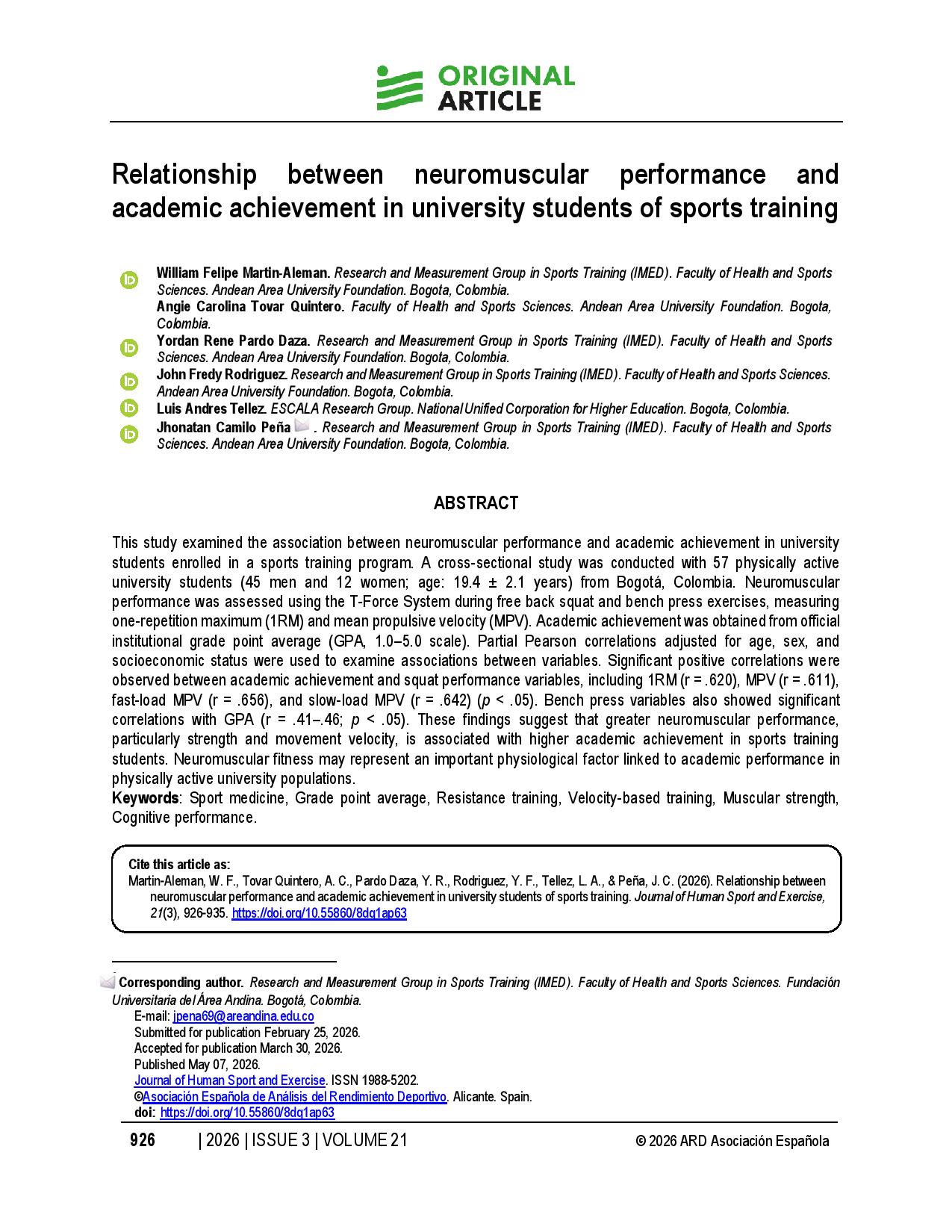
This study examined the association between neuromuscular performance and academic achievement in university students enrolled in a sports training program. A cross-sectional study was conducted with 57 physically active university students (45 men and 12 women; age: 19.4 ± 2.1 years) from Bogotá, Colombia. Neuromuscular performance was assessed using the T-Force System during free back squat and bench press exercises, measuring one-repetition maximum (1RM) and mean propulsive velocity (MPV). Academic achievement was obtained from official institutional grade point average (GPA, 1.0–5.0 scale). Partial Pearson correlations adjusted for age, sex, and socioeconomic status were used to examine associations between variables. Significant positive correlations were observed between academic achievement and squat performance variables, including 1RM (r = .620), MPV (r = .611), fast-load MPV (r = .656), and slow-load MPV (r = .642) (p < .05). Bench press variables also showed significant correlations with GPA (r = .41–.46; p < .05). These findings suggest that greater neuromuscular performance, particularly strength and movement velocity, is associated with higher academic achievement in sports training students. Neuromuscular fitness may represent an important physiological factor linked to academic performance in physically active university populations.
Downloads
Article Details
Section

This work is licensed under a Creative Commons Attribution-NonCommercial-ShareAlike 4.0 International License.
Each author warrants that his or her submission to the Work is original and that he or she has full power to enter into this agreement. Neither this Work nor a similar work has been published elsewhere in any language nor shall be submitted for publication elsewhere while under consideration by Journal of Human Sport and Exercise (JHSE). Each author also accepts that the JHSE will not be held legally responsible for any claims of compensation.
Authors wishing to include figures or text passages that have already been published elsewhere are required to obtain permission from the copyright holder(s) and to include evidence that such permission has been granted when submitting their papers. Any material received without such evidence will be assumed to originate from the authors.
Please include at the end of the acknowledgements a declaration that the experiments comply with the current laws of the country in which they were performed. The editors reserve the right to reject manuscripts that do not comply with the abovementioned requirements. The author(s) will be held responsible for false statements or failure to fulfill the above-mentioned requirements.
This title is licensed under a Attribution-NonCommercial-ShareAlike 4.0 International (CC BY-NC-SA 4.0).
You are free to:
Share — copy and redistribute the material in any medium or format.
Adapt — remix, transform, and build upon the material.
The licensor cannot revoke these freedoms as long as you follow the license terms.
Under the following terms:
-
Attribution — You must give appropriate credit, provide a link to the license, and indicate if changes were made. You may do so in any reasonable manner, but not in any way that suggests the licensor endorses you or your use.
-
NonCommercial — You may not use the material for commercial purposes.
-
ShareAlike — If you remix, transform, or build upon the material, you must distribute your contributions under the same license as the original.
- No additional restrictions — You may not apply legal terms or technological measures that legally restrict others from doing anything the license permits.
Notices:
- You do not have to comply with the license for elements of the material in the public domain or where your use is permitted by an applicable exception or limitation.
- No warranties are given. The license may not give you all of the permissions necessary for your intended use. For example, other rights such as publicity, privacy, or moral rights may limit how you use the material.
How to Cite



References
Albor, C., Dau, L., & Ruíz, L. (2014). Factores asociados a la deserción universitaria: Una revisión teórica. Revista Educación y Desarrollo Social, 8(1), 111-128.
Álvarez-Bueno, C., Pesce, C., Cavero-Redondo, I., Sánchez-López, M., Garrido-Miguel, M., & Martínez-Vizcaíno, V. (2017). Academic achievement and physical activity: A meta-analysis. Pediatrics, 140(6), e20171498. https://doi.org/10.1542/peds.2017-1498
Arango-Vélez, N., Peña, M., & López, D. (2020). Validation of the IPAQ in physically active university students. Revista Colombiana de Rehabilitación, 19(1), 40-48. https://doi.org/10.1016/S0121-8123(12)70038-5
Arias, A. M. (2013). Factores que influyen en el rendimiento académico en estudiantes universitarios. Revista Electrónica de Psicología Iztacala, 16(1), 34-51. https://doi.org/10.6018/reifop.16.2.181031
Banyard, H. G., Nosaka, K., & Haff, G. G. (2017). Reliability and validity of the load-velocity relationship to predict the 1RM back squat. Journal of Strength and Conditioning Research, 31(7), 1897-1904. https://doi.org/10.1519/JSC.0000000000001657
Cigarroa-Cuevas, M., & Zapata-Lamana, R. (2016). Efectos del ejercicio físico sobre la neurogénesis y función cognitiva. Revista de Neurociencias, 27(2), 123-132.
Chung, J. (2021). Physical fitness and GPA in collegiate athletes: A cross-sectional analysis. Journal of Sports Science and Medicine, 20(4), 640-647.
Donnelly, J. E., Hillman, C. H., Castelli, D., et al. (2016). Physical activity, fitness, cognitive function, and academic achievement in children: A systematic review. Medicine & Science in Sports & Exercise, 48(6), 1197-1222. https://doi.org/10.1249/MSS.0000000000000901
Edel, R. (2003). El rendimiento académico: Concepto, investigación y desarrollo. Revista Iberoamericana de Educación, 33(1), 1-12. https://doi.org/10.35362/rie3312872
Edwards, N. M., Rehrer, N. J., & Humphries, D. (2022). Power-velocity profiling in aging adults: Associations with metabolic health markers. Journal of Aging and Physical Activity, 30(3), 447-455.
Erickson, K. I., Voss, M. W., Prakash, R. S., Basak, C., Szabo, A., Chaddock, L., … & Kramer, A. F. (2011). Exercise training increases size of hippocampus and improves memory. Proceedings of the National Academy of Sciences, 108(7), 3017-3022. https://doi.org/10.1073/pnas.1015950108
Esteban-Cornejo, I., Tejero-González, C. M., Sallis, J. F., & Veiga, O. L. (2014). Physical activity and cognition in adolescents: A systematic review. Journal of Science and Medicine in Sport, 18(5), 534-539. https://doi.org/10.1016/j.jsams.2014.07.007
García-Hermoso, A., Esteban-Cornejo, I., Olloquequi, J., & Ramírez-Vélez, R. (2017). Cardiorespiratory fitness and muscular strength as predictors of school performance. Journal of Pediatrics, 187, 127-133. https://doi.org/10.1016/j.jpeds.2017.04.012
González, C., & Ramírez, M. (2020). Factores de deserción en la educación superior: Revisión de literatura. Revista Educación, 44(1), 1-15.
González-Badillo, J. J., & Sánchez-Medina, L. (2010). Movement velocity as a measure of loading intensity in resistance training. International Journal of Sports Medicine, 31(5), 347-352. https://doi.org/10.1055/s-0030-1248333
Jiménez-Reyes, P., Samozino, P., Brughelli, M., & Morin, J.-B. (2017). Effectiveness of individualized training based on force-velocity profiling. Frontiers in Physiology, 7, 677. https://doi.org/10.3389/fphys.2016.00677
Luna, L., Peña, M., & Rodríguez, C. (2014). Influencia de los factores socioeconómicos y académicos en el rendimiento estudiantil universitario. Revista Colombiana de Educación, 66, 191-210.
Martínez-Abad, F., & Chaparro, S. (2020). Academic records as indicators of student performance: Assessment validation in higher education. Studies in Higher Education, 45(12), 2354-2367.
Ministerio de Educación Nacional. (2022). Tasa de deserción en educación superior por cohorte. Retrieved from [Accessed 2026, 21 April]: https://snies.mineducacion.gov.co/
Parejo-Blanco, F. (2014). Perfil fuerza-velocidad en el entrenamiento de la fuerza: Aplicaciones para el rendimiento físico-deportivo. Wanceulen.
Peña, G., García, J., & Martínez, L. (2019). Relación entre fuerza muscular y rendimiento académico en estudiantes universitarios colombianos. Revista Colombiana de Ciencias del Deporte, 15(2), 45-53.
Reloba, I., Chirosa, I. J., & Reigal, R. E. (2016). Influencia de la actividad física en el rendimiento cognitivo en escolares. Revista de Psicología del Deporte, 25(1), 57-64. https://doi.org/10.17060/ijodaep.2016.n2.v1.553
Restrepo, M., Vélez, C., & García, J. (2006). Factores asociados al rendimiento académico en estudiantes universitarios de primer año. Revista Colombiana de Educación, 50, 114-135.
Sarmiento, L. A., & López, D. M. (2019). Factores psicosociales relacionados con el bajo rendimiento académico en estudiantes universitarios. Revista Latinoamericana de Psicología, 51(2), 107-116.
Sillanpää, E., et al. (2014). Validity of bioelectrical impedance methods in physically active adults. European Journal of Clinical Nutrition, 68(12), 1358-1363.
Warburton, D. E. R., Bredin, S. S. D., Jamnik, V. K., & Gledhill, N. (2011). The PAR-Q+ and ePARmed-X+: Updated and enhanced screening tools. Health & Fitness Journal of Canada, 4(2), 3-17.